AI Data Centres and Water
Why India's Digital Boom Is Now a Water Risk Question?
Reading Time
5 min
Article Sections
6
Share Links
3
On This Page
Article Section
Introduction
AI data centres create water risk because cooling systems can evaporate large volumes of water, and the electricity powering them also uses water. In India, the risk depends on location, cooling design and season, so siting in water-stressed areas becomes a business decision, not only an environmental one.
Until recently, the debate around data centres focused on electricity. Rapid growth in AI and cloud infrastructure is now drawing attention to water availability, cooling technology and competition with farms, homes and industry for the same local supply.
This article explains why AI workloads can raise water demand, how cooling choices change consumption, and which questions companies and communities should ask about data centre water use in India.
Article Section
Why Data Centres Need Water?
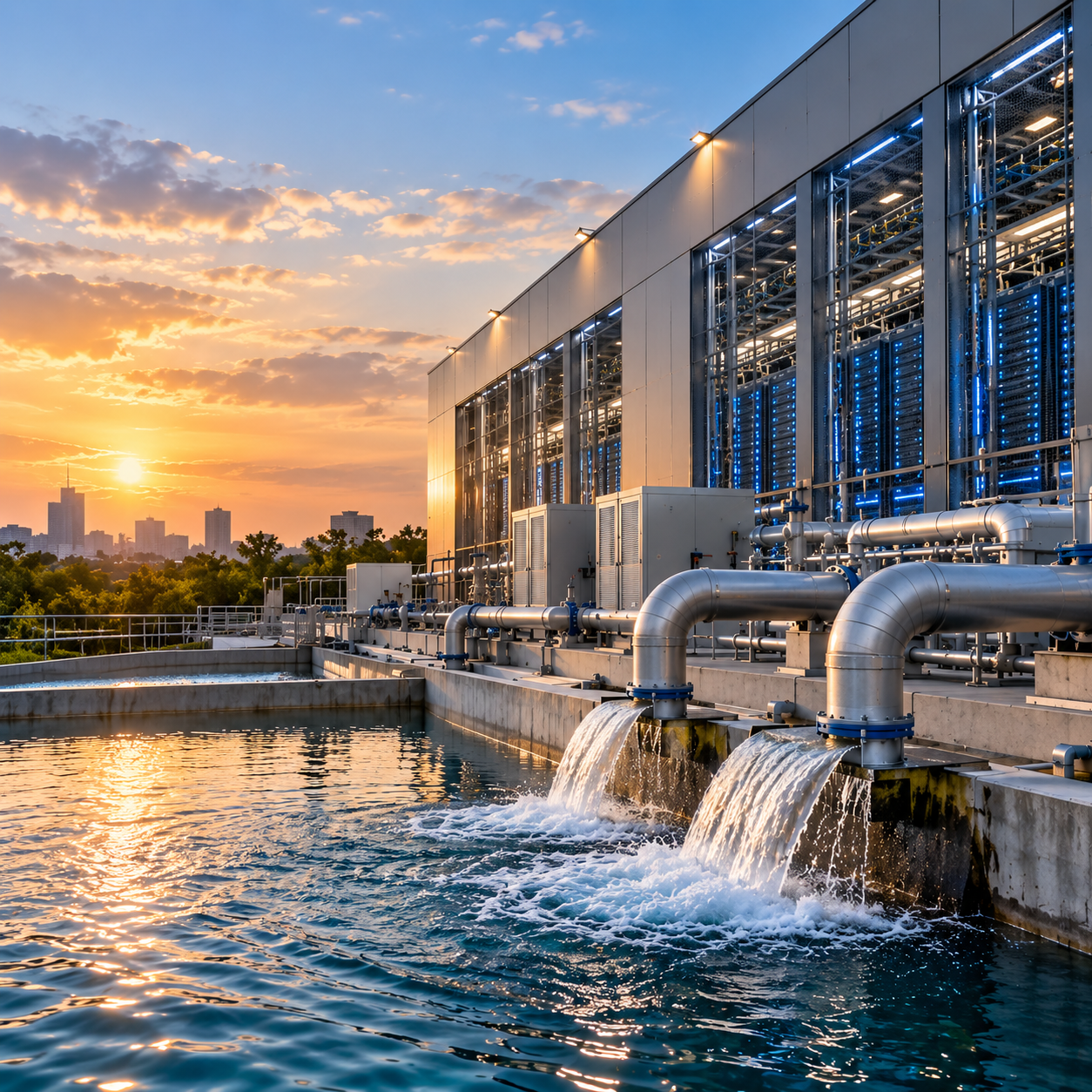
Servers turn almost all the electricity they draw into heat. If that heat is not removed, chips slow down or fail, so every data centre needs a cooling system. Water is widely used because it carries heat far better than air, the same principle behind a car radiator.
AI makes this harder. The chips used to train and run AI models, called GPUs, pack more computing power into each rack than conventional servers. Each rack therefore produces more heat that has to be removed.
Two terms matter throughout this article. Direct water use is the water a facility uses on site, mostly for cooling. Indirect water use is the water power plants consume to generate the electricity the facility buys. It also helps to separate withdrawal, which is water taken from a source, from consumption, which is water that does not return to that source, for example because it evaporates.
Article Section
AI Data Centre Cooling Water: How Design and Location Shape Demand?
Cooling methods and their water trade-offs
Evaporative cooling, which uses cooling towers, rejects heat by evaporating water. It is energy efficient but consumes water on site. Air-cooled systems use little or no water on site, but they usually need more electricity, especially in hot weather. Liquid cooling, where coolant runs close to the chips, suits dense AI racks and can be paired with either approach.
Direct and indirect water footprint
A facility that uses little water on site can still carry a large water footprint if its electricity comes from water-intensive generation, such as thermal power plants that use water for steam and cooling. Reading direct and indirect figures together gives a fuller picture of the water footprint of data centres than either alone.
What WUE tells you?
Water Usage Effectiveness (WUE) is the litres of water a data centre uses per kilowatt-hour of IT equipment energy, as defined in ISO/IEC 30134-9. It is useful for comparing sites, but it usually reflects on-site water only and changes with climate and season. A low figure reported for a cool month does not describe a hot summer.
Why no single water figure applies?
Water use at a facility depends on cooling design, local temperature and humidity, workload and how much recycled or treated water is used. A single universal estimate of AI data centre water use can therefore mislead. Site-level data is the better test.
The India lens: local and seasonal stress
Water stress in India is local. Supply depends on the river basin, groundwater condition and competing demand from agriculture, households and industry. Pressure often builds in the pre-monsoon months, when cooling demand is high and supply is frequently tightest. Location risk can be checked with tools such as the WRI Aqueduct Water Risk Atlas and Central Ground Water Board assessments.
Can data centres operate without freshwater?
Treated wastewater, recycled water and closed-loop cooling can reduce freshwater dependence, though each adds cost, energy use or treatment needs. Whether a site can avoid freshwater entirely depends on its cooling design and the treated water available nearby.
Article Section
Questions to Ask About Data Centre Water Use
For operators and technology companies
Publish WUE with its measurement period, cooling type and water source. Test candidate sites against water-stress data before committing, and plan for the driest months, not the annual average.
For investors and ESG teams
Ask for site-level water data, the share of recycled or treated water and contingency plans for supply disruption. Treat water, alongside power, as part of site and operational risk.
For policymakers
Water source approvals, reuse expectations and disclosure requirements for new sites are the practical levers. Clear expectations let operators choose cooling design early.
For local communities
Ask where the water comes from, whether it is freshwater or treated wastewater, and what the plan is during drought months.
Article Section
Conclusion
AI data centres link digital growth to local water supply through cooling and electricity. In India, location, cooling design and season decide how serious that link becomes.
As AI capacity grows, disclosure of WUE, water source and drought-month plans will be the practical test of whether operators have understood the risk.
Article Section
Frequently Asked Questions
How much water do AI data centres use?
It varies widely with cooling design, local climate, workload and water source, so no single figure applies to all sites.
Why do data centres need water?
Water carries heat away from servers, and AI chips produce more heat per rack than conventional servers.
Which parts of India face data centre water risk?
Risk depends on local water stress, so areas with tight groundwater or reservoir supply face more exposure, which can be checked with WRI Aqueduct and Central Ground Water Board data.
Are air-cooled data centres more sustainable, and can they run without freshwater?
Air cooling cuts on-site water use but usually raises electricity demand, which can shift water use to power generation. Recycled water and closed-loop cooling can reduce freshwater dependence, though not every site can avoid it entirely.
What is WUE in a data centre?
WUE, or Water Usage Effectiveness, is the litres of water used per kilowatt-hour of IT equipment energy, as defined in ISO/IEC 30134-9.
Keep Reading
Related Blogs

All Industries
Why Verification Will Decide Whether India's Carbon Market Can Be Trusted?
Why measurement, reporting and verification will determine CCC integrity
Read more
All Industries
The 31 July CCTS Deadline Has Passed
What Happens to Obligated Entities Now?
Read more
All Industries
Who Must Comply with India's Carbon Market Rules?
The Seven Sectors Entering the First Phase
Read moreNext Step
Ready to turn ESG complexity into strategic advantage?
Talk to ESG Astraa about disclosures, climate strategy, governance controls, and execution support for your team.