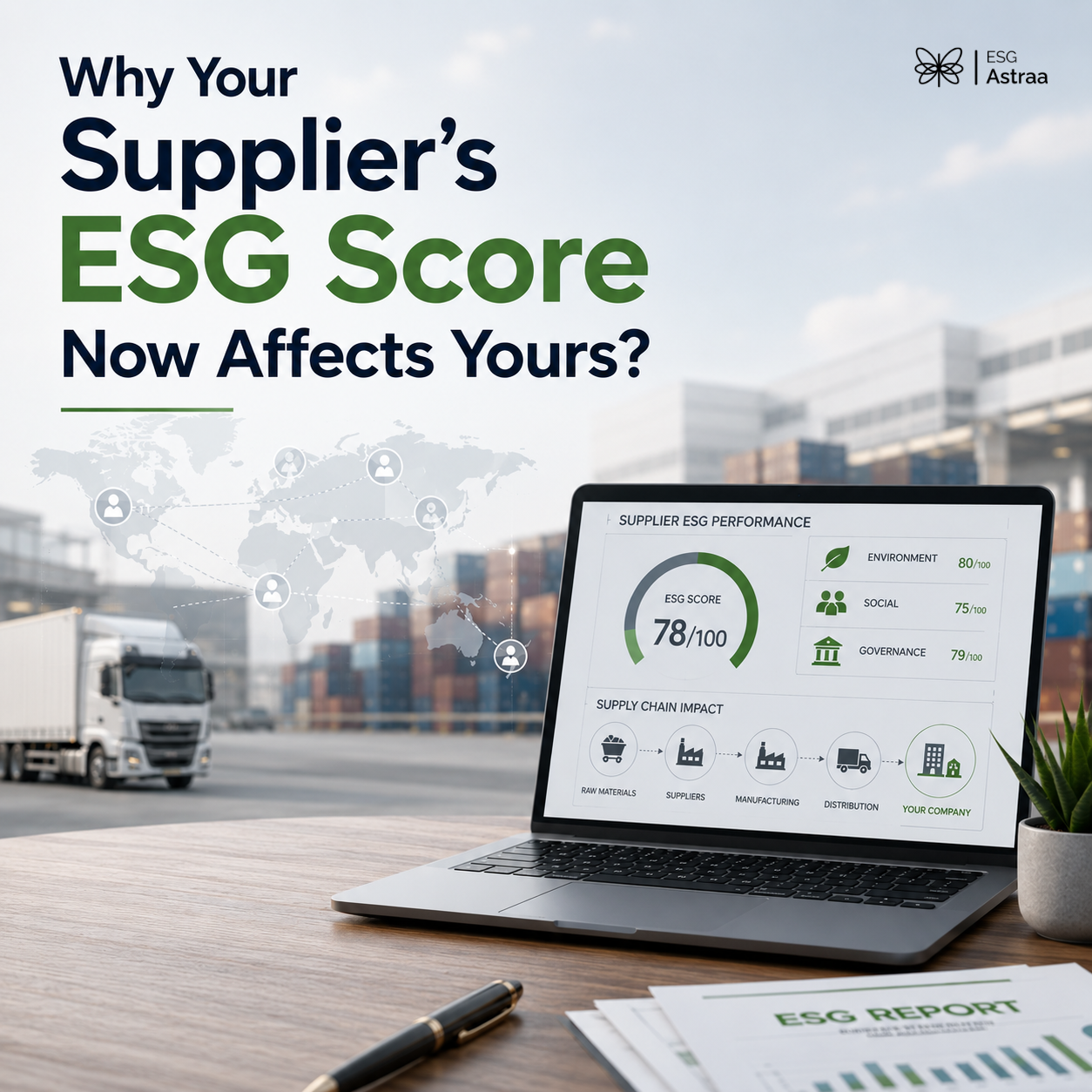
Why Your Supplier's ESG Score Now Affects Yours?
BRSR Value Chain Disclosure Explained
Reading Time
5 min
Article Sections
6
Share Links
3
On This Page
Article Section
Introduction
ESG reporting under BRSR was once primarily about what happens inside a company's own operations. That scope is widening. What a company's suppliers do, how they manage emissions, water, waste, and labour, is increasingly becoming part of that company's own ESG story, whether or not it appears as a mandatory disclosure line.
This matters because of how BRSR is structured. The top 1,000 listed companies by market capitalisation must report under BRSR, and the top 150 are subject to BRSR Core assurance requirements. Value chain disclosure was designed to extend this logic outward to significant suppliers, but SEBI's March 2025 circular made this layer voluntary rather than mandatory.
This article explains what BRSR value chain disclosure actually requires, why supplier ESG performance affects a reporting company even without a mandatory obligation, and what businesses should do to prepare.
Article Section
What BRSR Value Chain Disclosure Actually Says
BRSR Core is a defined subset of indicators within the broader BRSR framework, covering nine ESG attributes including GHG emissions, water and waste management, and employee wellbeing. SEBI originally proposed extending select Core indicators to a company's value chain, with this becoming mandatory for the top 150 listed entities by market capitalisation starting FY 2024-25.
SEBI's March 2025 circular changed this. Value chain disclosure and its assurance moved from mandatory to voluntary, on a comply or explain basis, in response to industry concerns about data availability, supplier readiness, and assurance cost. The correct regulatory term here is assessment or assurance, not reasonable assurance, which applies only to the reporting company's own BRSR Core indicators and not to the value chain layer.
SEBI defines value chain in this context using a specific threshold: significant value chain partners are upstream and downstream entities that individually account for 2% or more of the listed entity's purchases or sales by value. This is a defined cutoff, not an open-ended instruction to assess every vendor relationship.
Article Section
Why Supplier ESG Performance Still Affects Your Score?
Scope 3 emissions sit inside your own climate disclosures
Even where value chain BRSR reporting is voluntary, a company's Scope 3 emissions, which for most sectors represent the majority of total footprint, are increasingly expected in climate disclosures, investor questionnaires, and frameworks like the GHG Protocol. A supplier with poor emissions data or carbon-intensive processes directly inflates a reporting company's own Scope 3 number.
Institutional investors are asking past the disclosure line
Investors conducting ESG due diligence, particularly in sectors with complex supply chains like textiles, auto components, and consumer goods, increasingly request supplier-level data regardless of what is mandatory under BRSR. A company unable to answer these questions credibly faces a credibility gap with capital providers, even if it has technically met its regulatory disclosure obligations.
Reputational and contractual exposure travels up the chain
A supplier's labour violation, environmental incident, or governance failure becomes a reputational risk for the companies that source from them, independent of formal disclosure requirements. Customer-imposed supplier codes of conduct and ESG-linked procurement contracts are increasingly functioning as a parallel, contractual layer of value chain accountability.
Voluntary today does not mean voluntary indefinitely
SEBI's phased approach to BRSR Core, starting with the top 150 companies and with expansion plans into FY 2026-27, suggests value chain assurance requirements could tighten over time. Companies that build supplier data collection systems now, even while reporting remains voluntary, avoid a scramble later.
Article Section
What This Means for Your Business
Start mapping significant value chain partners now
Identify which suppliers and customers meet or approach the 2% purchase or sales threshold, since these are the partners most likely to be in scope if and when value chain disclosure requirements expand.
Build supplier ESG data collection into procurement, not just reporting
Embedding ESG data requests into vendor onboarding and contract renewal cycles is more sustainable than treating value chain disclosure as an annual reporting exercise bolted onto procurement after the fact.
Distinguish your voluntary disclosures clearly from your assured ones
Where a company chooses to disclose value chain data voluntarily, it should be clearly labelled as such, separate from BRSR Core indicators that may carry assessment or assurance obligations, to avoid creating an impression of assurance coverage that does not exist.
Article Section
Conclusion
BRSR value chain disclosure may be voluntary under current SEBI rules, but the influence of supplier ESG performance on a company's own climate numbers, investor relationships, and reputational standing is not optional in practice. The regulatory line and the business reality have diverged, and companies that only track the former are missing the latter.
As SEBI continues to phase in BRSR Core requirements and investor expectations around supply chain transparency deepen, companies that have already built supplier data infrastructure will be the ones positioned to respond quickly, whatever the next regulatory step turns out to be.
Article Section
Frequently Asked Questions
Is BRSR value chain disclosure mandatory in India?
No, SEBI's March 2025 circular made BRSR value chain disclosure and its assessment or assurance voluntary on a comply or explain basis.
What is the difference between BRSR Core and BRSR value chain disclosure?
BRSR Core covers a defined set of indicators for the reporting company's own operations, while value chain disclosure extends select indicators to significant upstream and downstream partners, currently on a voluntary basis.
How does a supplier's ESG performance affect a company's own BRSR or Scope 3 reporting?
Supplier emissions, water use, and labour practices feed directly into a reporting company's Scope 3 emissions and broader ESG narrative, regardless of whether formal value chain disclosure is mandatory.
What is the 2% threshold for significant value chain partners under BRSR?
SEBI defines significant value chain partners as upstream or downstream entities that individually account for 2% or more of the listed entity's purchases or sales by value.
Why did SEBI make value chain disclosure voluntary in its March 2025 circular?
SEBI cited industry concerns about data availability, supplier readiness, and the cost of assurance as the reasons for shifting value chain disclosure from mandatory to voluntary.
Keep Reading
Related Blogs
All Industries
ESG and the Indian SME
Why Small Suppliers Are Suddenly Under Pressure From Their Largest Clients
Read more
All Industries
Five ESG Metrics Every Investor Pitch in India Should Now Include
Most Still Don't Know
Read more
All Industries
Carbon Credits vs Carbon Offsets
Understanding the Difference Before Making Climate Claims
Read moreNext Step
Ready to turn ESG complexity into strategic advantage?
Talk to ESG Astraa about disclosures, climate strategy, governance controls, and execution support for your team.