What Are Carbon Credit Certificates?
Understanding India's New Compliance Currency
Reading Time
5 min
Article Sections
6
Share Links
3
On This Page
Article Section
Introduction
Until recently, an Indian company that cut its greenhouse gas emissions below the industry norm had no formal way to monetise that performance. The Carbon Credit Trading Scheme, 2023 changed that by creating a certificate that converts emission reduction into a tradable financial asset.
The Energy Conservation (Amendment) Act, 2022 gave the Central Government the legal power to set up this scheme, and the Ministry of Power notified the Carbon Credit Trading Scheme, 2023 on 28 June 2023. As India's first compliance cycles get underway, questions about what a Carbon Credit Certificate actually represents, who can earn one and how it differs from older instruments like Renewable Energy Certificates are becoming practical rather than theoretical.
This article explains what a CCC is, how it is issued and traded, and how it differs from voluntary carbon credits and other environmental certificates.
Article Section
What Is a Carbon Credit Certificate?
A Carbon Credit Certificate is a tradable instrument issued under India's Carbon Credit Trading Scheme, 2023 (CCTS), the framework that establishes the Indian Carbon Market. Its legal basis comes from the Energy Conservation (Amendment) Act, 2022, which inserted a provision into the Energy Conservation Act, 2001 empowering the Central Government to specify a scheme for issuing and trading carbon credit certificates. Acting on this power, the Ministry of Power notified the CCTS on 28 June 2023.
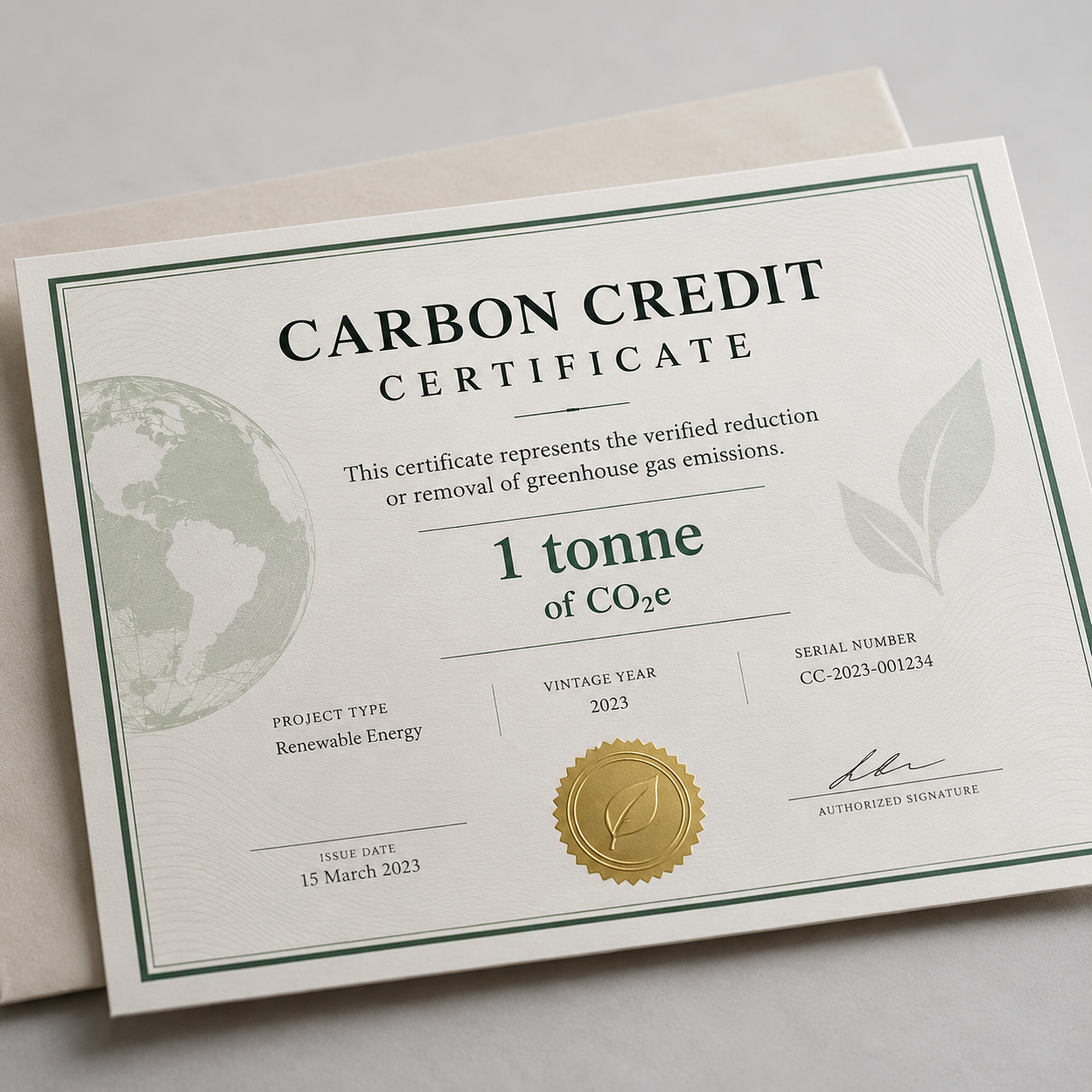
One CCC represents one tonne of carbon dioxide equivalent (tCO2e) that has been reduced, avoided or removed. The scheme builds on the existing Perform, Achieve and Trade (PAT) scheme, which already covered more than a thousand entities across thirteen energy-intensive sectors such as cement, steel and fertilisers, and gradually converts that energy-efficiency framework into a compliance carbon market.
There are two broad routes through which a CCC can be earned: a compliance mechanism for entities the government formally designates as obligated, and an offset mechanism for entities that are not obligated but choose to register eligible decarbonisation projects.
Article Section
How Carbon Credit Certificates Work?
Setting and Meeting Targets
For entities notified as obligated, the Ministry of Environment, Forest and Climate Change sets a greenhouse gas emission intensity target, based on recommendations from the Ministry of Power. Emission intensity measures the quantity of greenhouse gas released per unit of output. If an obligated entity's actual emission intensity for a compliance year turns out lower than its target, meaning it emitted less than required, the Bureau of Energy Efficiency issues CCCs to that entity for the excess reduction achieved. If the entity misses its target, it must acquire CCCs from the market equal to the shortfall.
Who Runs the Market?
The CCTS assigns distinct roles to separate institutions. The Bureau of Energy Efficiency administers the scheme and issues CCCs. The Grid Controller of India maintains the official registry that records certificate ownership and transactions. The Central Electricity Regulatory Commission regulates trading activity and registers the power exchanges on which CCCs change hands. A National Steering Committee for the Indian Carbon Market, co-chaired by the Ministry of Power and the Ministry of Environment, Forest and Climate Change, oversees the overall framework.
The Offset Mechanism for Non-Obligated Entities
In December 2023, the government amended the CCTS to direct the Bureau of Energy Efficiency to build an offset mechanism. Under this mechanism, entities that are not subject to a mandatory target, such as those outside the notified energy-intensive sectors, can register projects that reduce, remove or avoid emissions according to published sectoral methodologies, and earn CCCs for verified performance.
Article Section
Applying This in Practice
Confirm Whether You Are Obligated
Whether a CCC comes through the compliance route or the offset mechanism depends on whether an entity has been formally notified as obligated under the CCTS; this status determines which set of rules, targets and verification requirements apply.
Don't Confuse a CCC With an REC
A Renewable Energy Certificate evidences that a specific quantity of electricity was generated from a renewable source, and is used to meet Renewable Purchase Obligations set by electricity regulators. A CCC instead represents a verified quantity of greenhouse gas reduced, avoided or removed. The two instruments measure different things and are not interchangeable, even though policy discussions have proposed eventually consolidating them.
Track Certificates Through the Official Registry
Because the Grid Controller of India maintains the central registry for the Indian Carbon Market, any entity holding, transferring or retiring CCCs should verify certificate status directly through that registry rather than relying on secondary sources.
Article Section
Conclusion
A Carbon Credit Certificate turns a company's greenhouse gas performance against a government-set target into a defined, tradable unit, backed by a formal registry, regulator and administrator rather than a voluntary claim.
As India's compliance cycles mature and the offset mechanism brings in more non-obligated entities, the CCC is positioned to become a more prominent reference instrument for decarbonisation in the country, though its relationship with older instruments like RECs is still being worked out through ongoing regulation.
Article Section
Frequently Asked Questions
What is a Carbon Credit Certificate?
A Carbon Credit Certificate is a tradable instrument issued under India's Carbon Credit Trading Scheme, 2023, where each certificate represents one tonne of carbon dioxide equivalent reduced, avoided or removed.
How is a CCC created in India?
The Bureau of Energy Efficiency issues a CCC either to an obligated entity that outperforms its government-set emission intensity target, or to a non-obligated entity whose registered project meets an approved offset methodology.
Who can receive CCCs?
Both obligated entities regulated under the CCTS compliance mechanism and non-obligated entities that register eligible projects under the offset mechanism can receive CCCs.
Can CCCs be traded?
Yes, CCCs are traded on power exchanges registered with the Central Electricity Regulatory Commission, with all transactions recorded in the Grid Controller of India's registry.
Are CCCs the same as voluntary carbon offsets?
Not quite: CCCs are certified under a government-notified scheme with a national registry, while conventional voluntary carbon credits come from independent international registries outside any Indian government mandate.
Keep Reading
Related Blogs

Carbon Markets
India's Carbon Credit Trading Scheme Has Launched
What Every Listed Company Must Do Now?
Read more
Carbon Markets
The Carbon Turning Point for Indian Business
The Indian Carbon Market Is No Longer a Future Event
Read more
Carbon Markets
India's Green Credit Programme vs Carbon Credits
Are They the Same Thing? No. Here's Why
Read moreNext Step
Ready to turn ESG complexity into strategic advantage?
Talk to ESG Astraa about disclosures, climate strategy, governance controls, and execution support for your team.