What Is the CBAM Registry?
Article 1 min read
Why importers need to know this now
By ESG Astraa Advisory Team
In brief
The Carbon Border Adjustment Mechanism, or CBAM, is the European Union's system for pricing the carbon embedded in certain imported goods, including iron, steel, aluminium, cement, and fertiliser.
- The CBAM Regulation under which the Registry operates
- 2023/956
- Registry access opened to accredited verifiers
- 1 September 2026
- Declarants purchase and surrender CBAM certificates through the Registry
- From 2027
In this article
Introduction
An Indian steel exporter recently received an email from its German buyer asking whether the shipment was covered under "Registry status." The exporter had not heard the term before and had no clear answer to give.
What is the CBAM Registry?
The CBAM Registry is the digital infrastructure that sits underneath this system. It is a centralised IT platform, operated by the European Commission under Regulation (EU) 2023/956, where the EU records who is authorised to import CBAM goods and tracks the data those imports generate.
Exhibit 1
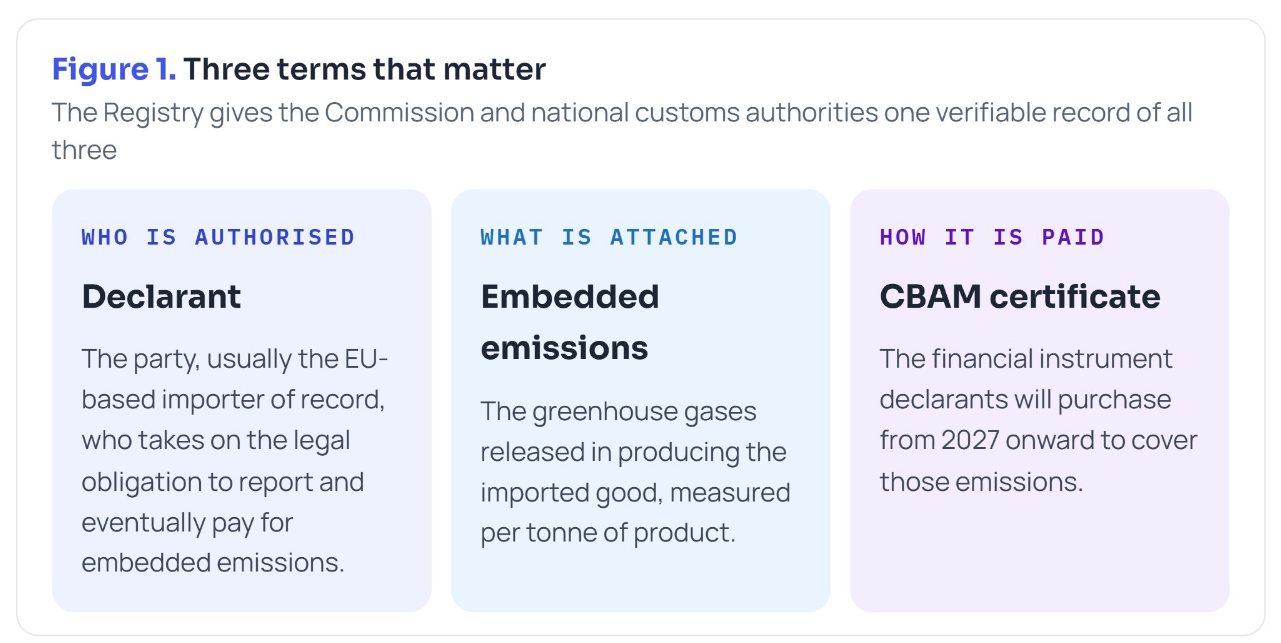
How the Registry fits into CBAM
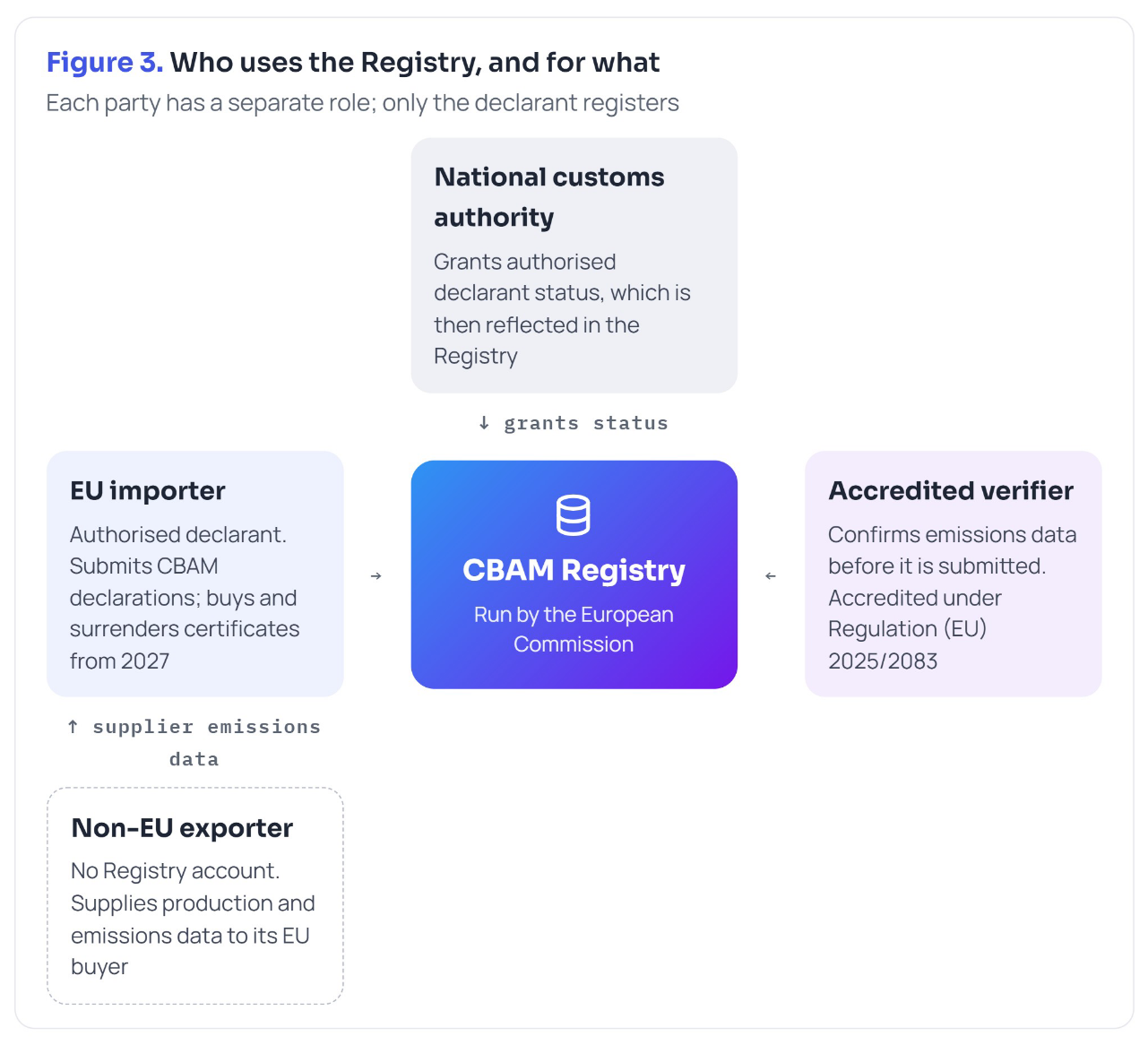
Authorisation happens at the level of the individual importer, not the shipment. Once approved, the declarant's status and details are entered into the Registry, and from that point the Registry becomes the record system for every later CBAM obligation.
Exhibit 2
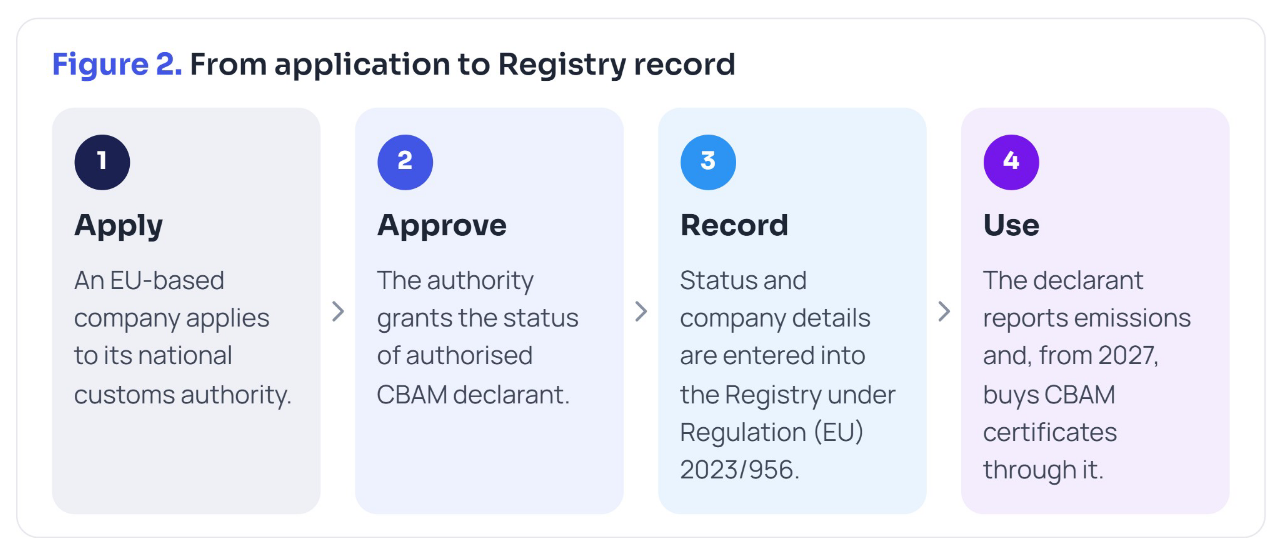
Exhibit 3
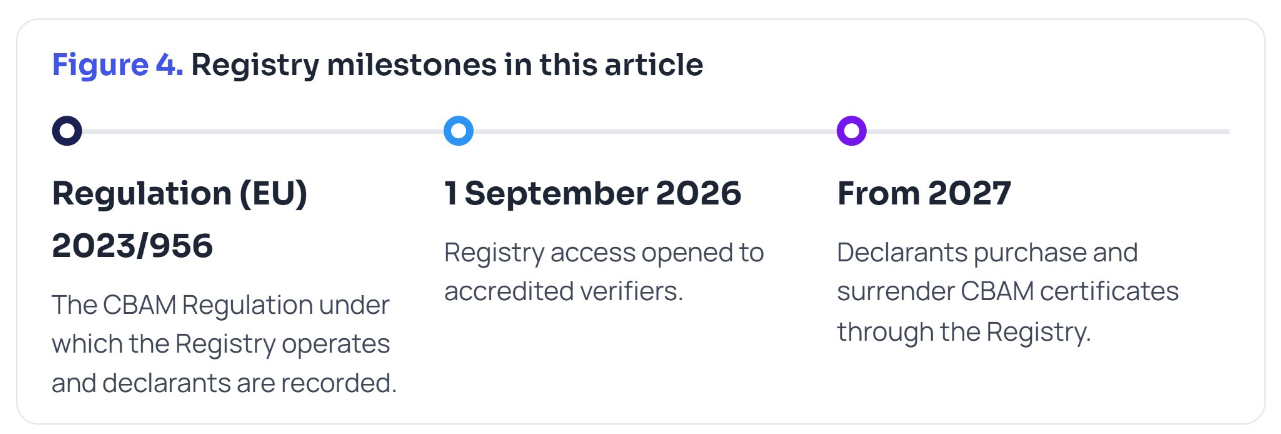
Exhibit 4
What data moves through the Registry?
Authorised declarants use the Registry to submit CBAM declarations reporting the embedded emissions in their imports, based on supplier emissions data and the methodology set out in Regulation (EU) 2023/956. From 2027, the Registry also becomes the point where declarants purchase and surrender CBAM certificates to cover those emissions.
What this means for exporters
A company or its customs broker having a login to the Registry does not by itself confirm CBAM authorisation. Authorisation is granted by a national customs authority and then reflected in the Registry, not the other way around.
The record-keeping backbone of CBAM
The CBAM Registry is best understood as the record-keeping backbone of the carbon border adjustment mechanism, not a compliance milestone in itself. It confirms who is authorised to import CBAM goods and holds the emissions data tied to those imports.
Frequently asked questions
- What is the CBAM Registry?
- It is the European Commission's centralised IT system established under Regulation (EU) 2023/956 to record authorised declarants and track CBAM-related transactions and emissions data.
- Do non-EU exporters need to register directly in the CBAM Registry?
- No, direct registration is limited to authorised CBAM declarants (typically EU importers). Exporters supply their production and emissions data directly to their EU buyer rather than opening a Registry account.
- Does having access to the CBAM Registry mean a company is authorised?
- No, Registry access is not the same as authorisation. Authorisation is granted by a national customs authority first and subsequently reflected in the Registry system.
Where ESG Astraa can help


About the author
ESG Astraa Advisory Team. ESG Astraa helps Indian companies collect ESG data, calculate emissions and file BRSR and other disclosures, with advisors alongside the software.