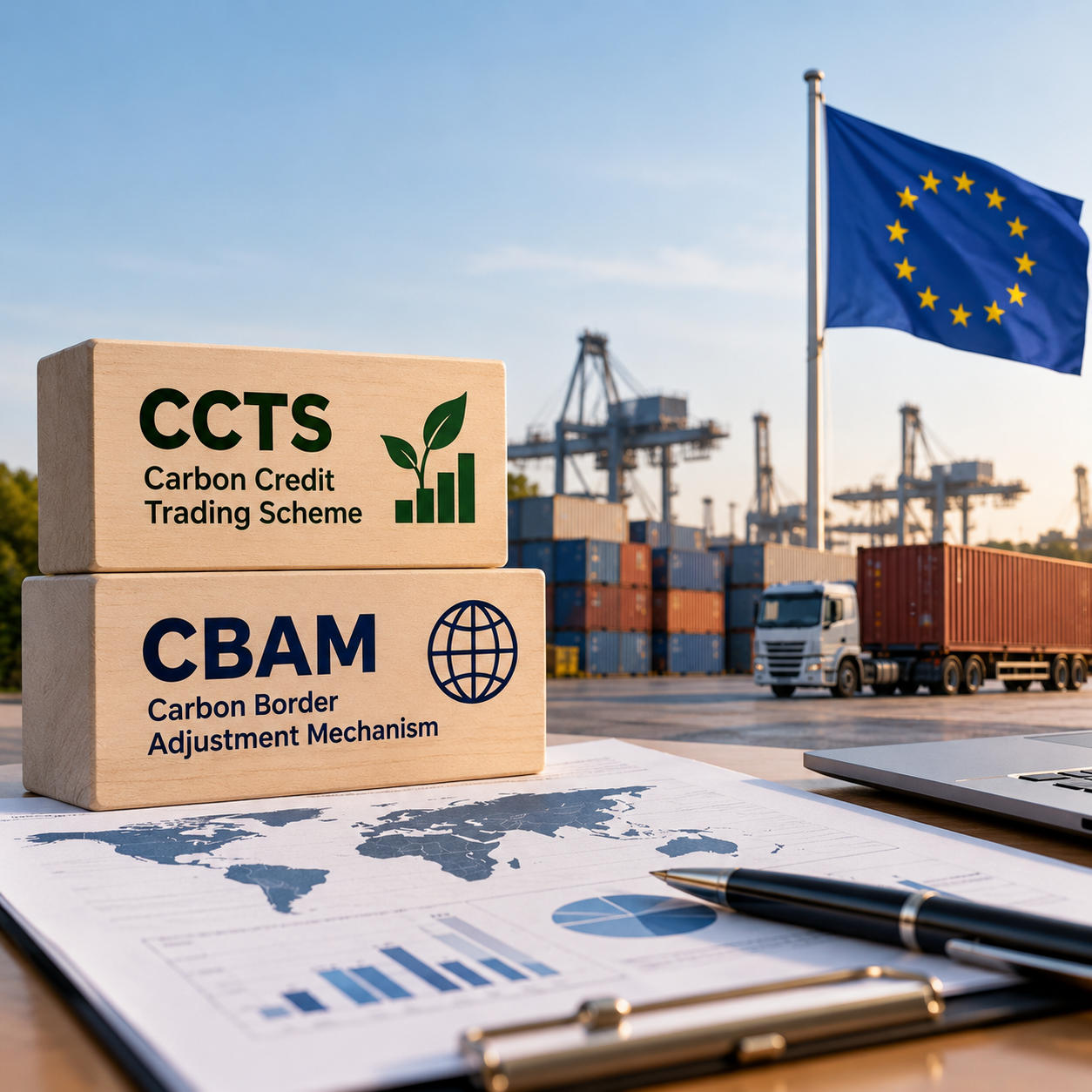
CCTS and CBAM
Will India's Domestic Carbon Market Reduce Exporters' EU Liability?
Reading Time
5 min
Article Sections
6
Share Links
3
On This Page
Article Section
Introduction
It is tempting to assume that once India has its own carbon market, Indian exporters can simply deduct what they have paid at home from what they owe at the EU border. The reality is more conditional than that.
CBAM entered its definitive phase on 1 January 2026, and the EU is only now finalising the detailed rules for how a third-country carbon price like CCTS could even qualify for deduction under Article 9.
This guide explains how CCTS and CBAM actually relate, why their accounting structures differ, and why domestic compliance does not automatically produce a full CBAM deduction. CCTS compliance does not, on its own, guarantee reduced CBAM liability, and that limitation is worth stating plainly before going further.
Article Section
What CBAM Actually Requires?
CBAM is the EU's carbon price on imported goods, established under Regulation (EU) 2023/956, covering steel, aluminium, cement, fertilisers, hydrogen and electricity.
The definitive regime has applied since 1 January 2026. CBAM certificate sales open on 1 February 2027, and the first annual declaration, covering 2026 imports, is due by 30 September 2027.
The legal obligation sits with the EU importer, who must hold authorised CBAM declarant status and file the annual declaration, though the cost and the data burden flow back to the exporter through pricing and contract terms.
Article 9 of the CBAM regulation allows a deduction for a carbon price effectively paid in the country of production, but the exact criteria for what qualifies are still being finalised through an EU implementing act.
Article Section
Why CCTS May Not Automatically Qualify?
The core issue, stated directly
CCTS compliance in India does not automatically guarantee a reduction in CBAM liability. As of one detailed July 2026 analysis, India's CCTS had not cleared the Article 9 bar, a status distinct from the UK's separate CBAM regime, which has recognised CCTS.
Why the two mechanisms do not map simply?
CBAM's Article 9 asks whether a scheme reflects a genuine, binding, non-discriminatory carbon price, while CCTS operates on a baseline-and-credit logic, earning tradable certificates rather than a straightforward per-tonne price payment. The European Commission has been actively weighing how to treat credit-based systems differently from a direct carbon tax or a cap-and-trade price.
The EU-India FTA angle
A carbon-cooperation annex in the January 2026 India-EU Free Trade Agreement gives India a most-favoured-nation style protection against being treated worse than other countries under any future CBAM flexibility, and commits both sides to technical cooperation on recognising carbon-pricing systems. This is protection from discrimination, not automatic recognition.
The UK contrast, kept clearly separate
The UK's own, separate CBAM regime, due to begin 1 January 2027, has included CCTS on its indicative list of qualifying overseas carbon pricing mechanisms, with BEE receiving formal confirmation from HM Treasury. This is a UK-specific development and should not be read across to the EU's still-unresolved Article 9 status.
The scale of what a deduction would offset
The EU's own CBAM default-value methodology illustrates the scale involved: Indian hot-rolled coil carries a default value of 4.7 tonnes of CO2 equivalent per tonne, incurring a default cost of roughly EUR250 per tonne at a EUR75 CBAM certificate price. Any deduction India's carbon price eventually qualifies for would be set against costs of this order.
Article Section
What Exporters Need to Prepare?
Do not assume automatic deduction
Budget for CBAM exposure as if no deduction applies yet, and treat any future recognition as an upside rather than a planning assumption.
Track the EU's Article 9 implementing act closely
This single piece of rulemaking will determine what, if anything, CCTS can offset, and it remained unfinalised as of the most recent reporting reviewed.
Distinguish UK and EU CBAM regimes explicitly
UK recognition of CCTS does not extend to the EU market, so keep these two regulatory tracks clearly separate in internal planning and external communication.
Build the evidence trail regardless
Embedded emissions data, verified carbon cost paid, and documentation meeting EU verification standards will all be needed if and when deduction becomes possible.
Watch the FTA's technical cooperation track
This is a plausible channel through which future recognition could develop, separate from the Article 9 rulemaking itself.
Article Section
Conclusion
CCTS and CBAM are related but not yet linked in a way that reduces EU liability for Indian exporters. That gap is a live regulatory question, not a settled one, and it deserves to be treated that way in planning.
Prepare CBAM documentation and cost exposure independently of any assumed CCTS deduction, and revisit this as the EU's Article 9 rules finalise.
Article Section
Frequently Asked Questions
Does CCTS reduce CBAM payments?
Not automatically. As of the most recent reporting available, India's CCTS has not been recognised for a deduction under the EU CBAM's Article 9 provision.
Is India's carbon price recognised under CBAM?
Not under the EU's CBAM as of the most recent reporting reviewed, though the UK's separate CBAM regime has recognised CCTS for its own carbon price relief mechanism.
Which Indian exporters face CBAM?
Exporters of steel, aluminium, cement, fertilisers, hydrogen and electricity to the EU fall within CBAM's current scope.
How are embedded emissions calculated?
The EU applies default values by product, such as a stated figure for hot-rolled coil, unless an exporter supplies verified actual emissions data instead.
What evidence will exporters need?
Verified embedded emissions data and documentation of any carbon cost actually paid in India, prepared to standards the EU's verification process can accept.
Keep Reading
Related Blogs

Carbon Markets
India's Carbon Credit Trading Scheme Has Launched
What Every Listed Company Must Do Now?
Read more
EU Regulation
What the EU Carbon Border Adjustment Mechanism Actually Costs an Indian Exporter in 2026
CBAM's definitive phase began on January 1, 2026. For Indian steel, aluminium, cement, and fertiliser exporters, that means real financial obligations — not just reporting.
Read more
Manufacturing
ESG in Manufacturing
Closing the Gap Between Ambition and Decarbonisation
Read moreNext Step
Ready to turn ESG complexity into strategic advantage?
Talk to ESG Astraa about disclosures, climate strategy, governance controls, and execution support for your team.