India's Carbon Market Is Live, But Can It Deliver a Credible Carbon Price?
The market-design, MRV, liquidity and enforcement tests ahead

Reading Time
5 min
Article Sections
6
Share Links
3
On This Page
Article Section
Introduction
A carbon market can exist legally, with registered entities, verified data and a functioning exchange, and still fail to produce a price that means anything. Existing is not the same as working.
IEEFA's 2026 analysis frames the next two to five years of CCTS as decisive, arguing that design choices made now will determine whether the market becomes genuinely investment-grade or remains largely an administrative exercise.
This guide walks through the major tests CCTS still faces, based on IEEFA's own analysis and the market mechanics established earlier in this series, keeping what is confirmed design separate from what remains open analysis.
Article Section
What Working Would Actually Mean?
IEEFA draws a distinction between a market that exists administratively and one capable of guiding capital-intensive industrial investment over 15-to-30-year cycles. The two are not the same achievement.
The precondition for real function, in IEEFA's framing, is genuine scarcity of certificates and credible enforcement, without which the market cannot produce a signal participants can actually rely on.
This matters beyond price alone. IEEFA connects credibility directly to whether CCTS can actually influence investment decisions, not just generate compliance paperwork that satisfies a regulatory requirement without changing industrial behaviour.
What follows separates two kinds of claim. Some things about CCTS are already settled design, such as its sector coverage and its verification chain. Others remain open questions that IEEFA and market analysts are still watching play out, and this piece keeps the two apart rather than blending them into a single forecast.
Article Section
The Tests Ahead
MRV credibility
Confirmed: a defined monitoring, reporting and verification chain exists, with mandatory independent ACVA verification, as established earlier in this series. Open: whether this holds up at scale once check verification and dispute cases become common, rather than only in a controlled first cycle.
Enforcement
IEEFA names credible enforcement as a precondition, alongside genuine scarcity, for the market to function as intended. This has no track record yet, since the current cycle is the first the scheme has run through.
Liquidity and price discovery
Confirmed: the price band mechanism and exchange structure exist, as established earlier in this series. IEEFA notes that early market dynamics in any emissions trading system reflect a learning period, and expects liquidity and price discovery to evolve over successive compliance cycles rather than arrive fully formed.
Cross-policy interaction risk
IEEFA flags that CCTS interacts with parallel policies, including the PAT scheme, Renewable Consumption Obligations, the PLI scheme and the National Green Hydrogen Mission. Each independently affects emissions in covered sectors, and without periodic baseline revision accounting for their cumulative impact, IEEFA warns these instruments risk generating credit surpluses that weaken the market signal, a dynamic it compares to problems that undermined the EU scheme's early price formation.
Sector sequencing and power-sector exclusion
Confirmed: the power sector is excluded from CCTS's initial phase. IEEFA frames this as simplifying implementation while deferring harder questions, calling for future integration to weigh where carbon pricing fits among power-sector measures, alongside electricity market regulation, dispatch decisions and cost recovery mechanisms.
International recognition
As covered earlier in this series, EU recognition under CBAM's Article 9 remains unresolved, while UK recognition has occurred separately. This connects domestic credibility directly to trade-facing outcomes for exporters.
Article Section
What Determines the Outcome?
Baseline revision discipline
Whether regulators periodically adjust baselines for cross-policy effects will shape whether credit surpluses accumulate over time.
How quickly liquidity builds?
A market's first few compliance cycles typically set the tone for how much genuine trading follows in later years.
Whether enforcement is visibly applied
The first cases of penalty or consequence for missed obligations will signal whether credible enforcement is real or remains aspirational.
How international recognition develops?
Progress, or the lack of it, on CBAM Article 9 and similar tracks will affect how much value Indian industry sees in the domestic market.
Whether power-sector integration follows
IEEFA frames this as a matter of sequencing rather than a permanent exclusion, worth watching over the medium term.
Whether stakeholders stay engaged with market design
Consultation processes on price bands, sector expansion and baseline revision are ongoing rather than closed, so continued participation from industry and analysts can still shape the outcome.
Article Section
Conclusion
CCTS exists. Whether it becomes a market that actually shapes industrial investment, rather than one that simply processes compliance paperwork, depends on a specific set of design choices still being made over the next several years.
Track these open questions, not just the compliance calendar, since they will determine what the market is actually worth to participants over time.
Article Section
Frequently Asked Questions
Is India's carbon market working?
It exists and is legally operational, but IEEFA frames whether it becomes genuinely investment-grade as still dependent on design choices being made over the next two to five years.
What are the biggest challenges for CCTS?
IEEFA points to enforcement credibility, certificate scarcity, cross-policy interaction risk, liquidity and price discovery, and sector sequencing as the major open questions.
Will CCTS create a meaningful carbon price?
That depends on liquidity, enforcement and how baseline-setting accounts for overlapping policies, all of which IEEFA identifies as still unresolved rather than guaranteed.
Will the power sector join CCTS?
It is excluded from the initial phase, and IEEFA frames this as a sequencing choice that leaves room for future integration rather than a permanent exclusion.
What will determine the future of India's carbon market?
Baseline revision discipline, how quickly genuine trading liquidity builds, visible enforcement, and progress on international recognition such as CBAM Article 9.
Keep Reading
Related Blogs

Carbon Markets
India's Carbon Credit Trading Scheme Has Launched
What Every Listed Company Must Do Now?
Read more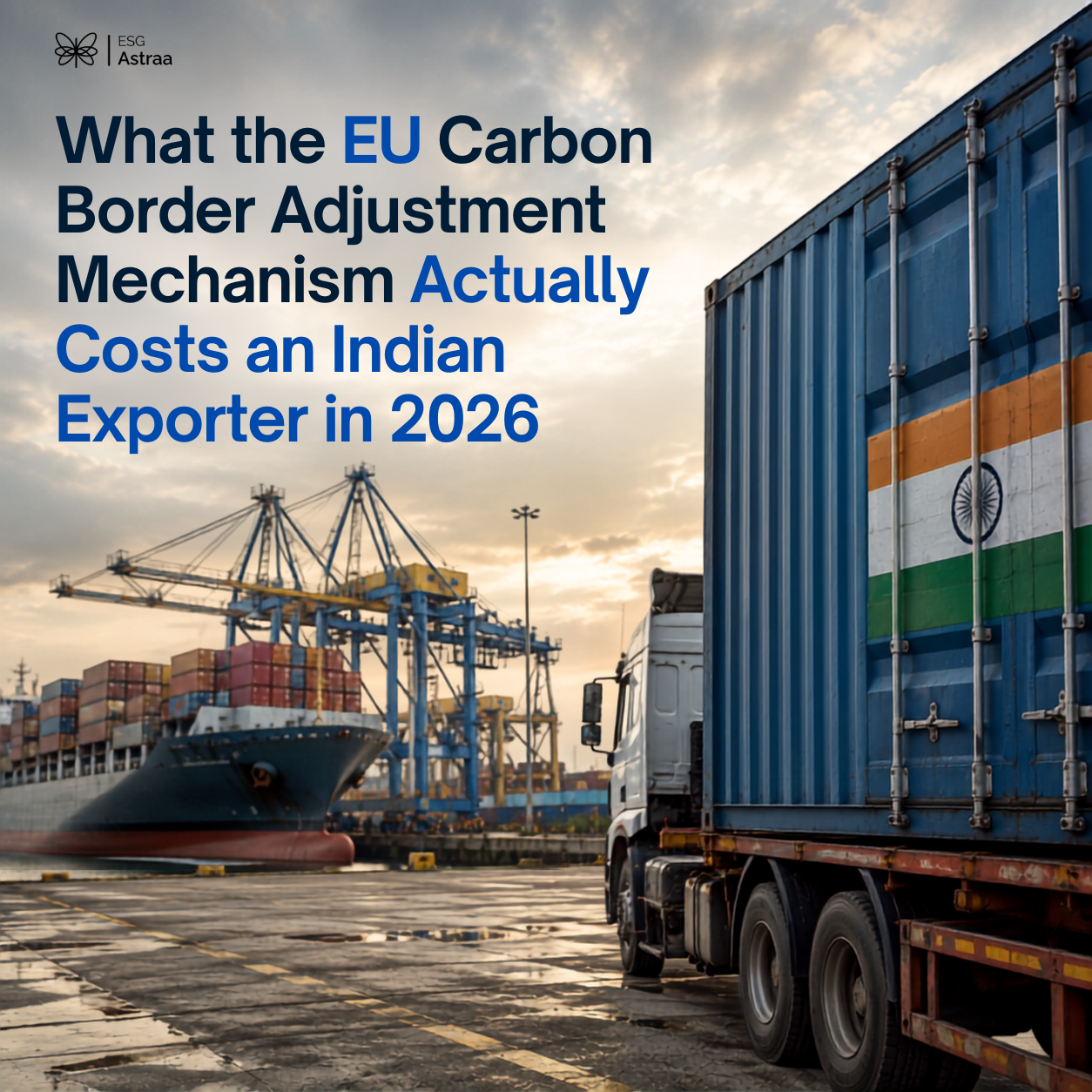
EU Regulation
What the EU Carbon Border Adjustment Mechanism Actually Costs an Indian Exporter in 2026
CBAM's definitive phase began on January 1, 2026. For Indian steel, aluminium, cement, and fertiliser exporters, that means real financial obligations — not just reporting.
Read more
Manufacturing
ESG in Manufacturing
Closing the Gap Between Ambition and Decarbonisation
Read moreNext Step
Ready to turn ESG complexity into strategic advantage?
Talk to ESG Astraa about disclosures, climate strategy, governance controls, and execution support for your team.