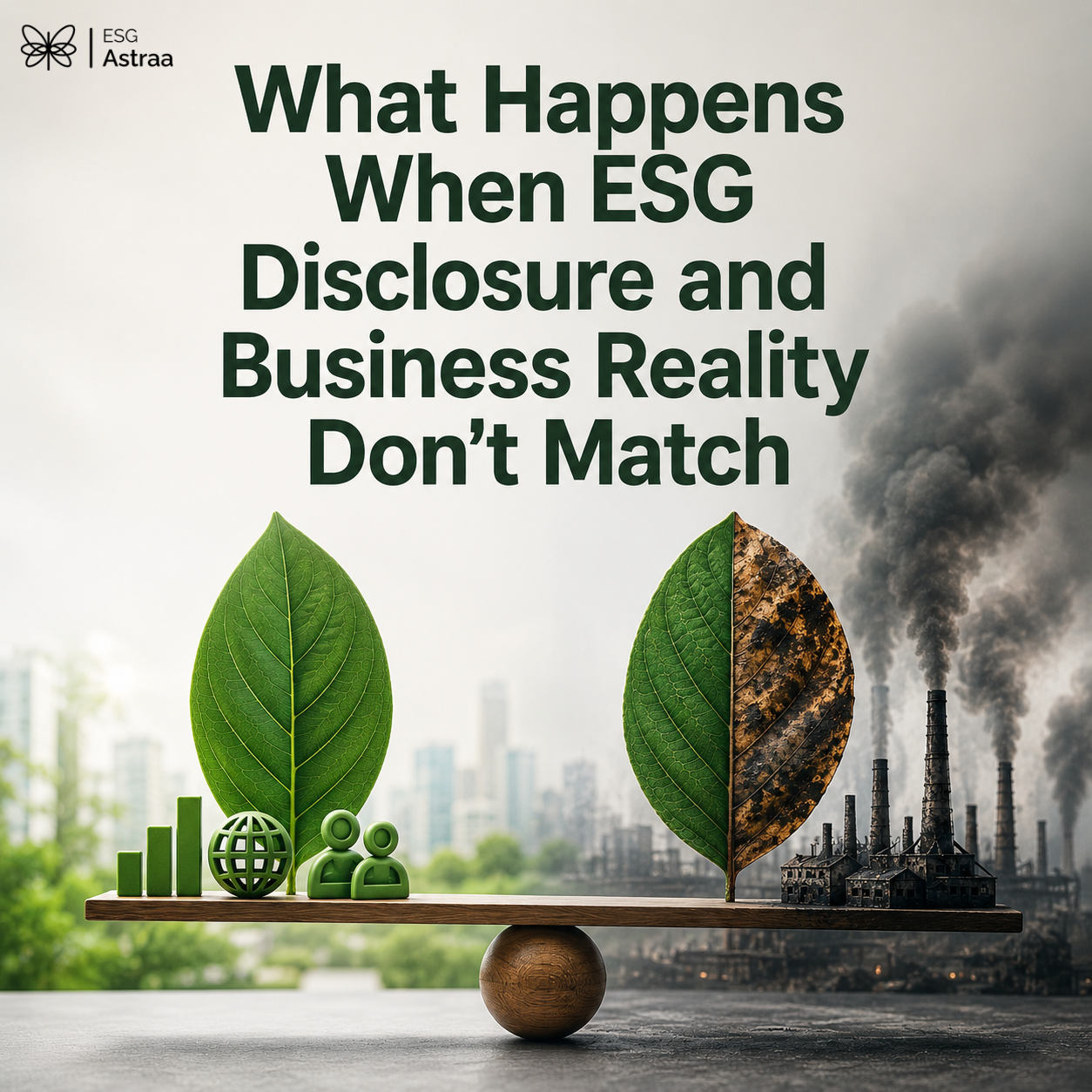
What Happens When ESG Disclosure and Business Reality Don't Match
The Greenwashing Risk Explainer
Reading Time
7 min
Article Sections
6
Share Links
3
On This Page
Article Section
Introduction
ESG disclosure volumes across Indian listed companies have grown sharply since BRSR became mandatory in FY2022-23. More companies are reporting more data across more indicators than at any point in India's corporate sustainability history. But volume is not the same as credibility. The gap between what companies disclose and what they can actually verify, substantiate, or deliver against is widening in a significant number of cases.
Greenwashing which is the practice of overstating or misrepresenting ESG performance, is not always deliberate. It frequently results from poor data governance, undocumented methodology, aspirational language that has outpaced operational reality, or a failure to disclose what is not known alongside what is. The consequences, however, are not moderated by intent.
The regulatory stakes are rising, investor scrutiny is becoming more technical, and Indian companies with EU supply chain or international investor relationships face indirect exposure to greenwashing enforcement frameworks that are already active abroad. This piece maps where the risk sits and what creates it.
Article Section
What Greenwashing Actually Is in an ESG Disclosure Context?
Greenwashing in a corporate disclosure context is broader than outright fraud. It covers a spectrum of practices: unverifiable claims, selective presentation of positive metrics while omitting negative ones, aspirational language without supporting data, targets without credible plans, and disclosures that are technically accurate in isolation but misleading in aggregate. Most companies that face greenwashing risk sit in the middle of this spectrum; not deliberately misrepresenting, but not meeting the evidentiary standard that the disclosure implies.
Claiming net zero by a target year without a verified emissions baseline, a costed transition plan, or a defined pathway is aspirational framing, not a credible commitment. Reporting emissions reductions that reflect a change in the organisational boundary rather than actual performance improvement is a boundary manipulation that can mislead without any single figure being technically wrong.
There is also the Scope 3 omission problem. Companies that report Scope 1 and 2 emissions while the majority of their footprint sits in the value chain, are presenting a partial picture as if it were complete. As investor and regulatory frameworks expand their focus to value chain emissions, this omission is increasingly read as a disclosure gap rather than a legitimate boundary choice.
The distinction between greenwashing and honest uncertainty matters. Not every disclosure gap reflects bad faith. Data systems take time to build, methodologies are still being standardised, and some ESG issues are genuinely difficult to measure. The test is whether the limitation is disclosed.
Article Section
Where the Regulatory and Legal Risk Now Sits?
SEBI's Framework and What It Covers
Material misstatement in BRSR is a regulatory breach under the SEBI Listing Obligations and Disclosure Requirements Regulations 2015. BRSR is part of the annual report . As BRSR Core assessment or assurance extends to the top-1000 listed companies by FY2026-27, the verification layer is becoming more rigorous. Claims that cannot survive third-party assessment scrutiny are surfacing during engagement, not after publication. SEBI's May 2024 circular on Green Debt Securities introduced explicit greenwashing provisions for green bond issuers: prohibition on misleading labels, continuous use-of-proceeds monitoring, prohibition on fund diversion to non-green purposes, and a requirement to highlight unfavourable information alongside favourable disclosures. While these provisions apply specifically to green bond issuers, they signal the direction of SEBI's regulatory posture on ESG disclosure quality more broadly.
Investor and Rating Agency Scrutiny
ESG rating agencies including MSCI, Sustainalytics, and CDP independently assess companies using third-party data sources, news monitoring, and regulatory filings and not just the BRSR. Disclosures that cannot be corroborated against these sources create scoring gaps and, in some cases, downgrades or controversy flags that are visible to institutional investors. A company that claims strong environmental performance in its BRSR while emissions data or regulatory incident records tell a different story will not be protected by the BRSR disclosure alone. Institutional investors are increasingly conducting ESG due diligence that goes beyond reading the BRSR. Engagement letters, ESG questionnaires, and pre-AGM ESG reviews are now standard for large-cap Indian companies with significant FPI ownership. Disclosure gaps and inconsistencies surface in these processes.
The International Regulatory Trajectory
Indian companies are not directly subject to the EU's CSRD or the UK's Sustainability Disclosure Requirements. But Indian companies supplying EU clients are already subject to CSRD value chain due diligence as their EU clients need verifiable supplier ESG data to complete their own regulatory disclosures. ESG claims that cannot be substantiated under this scrutiny create commercial risk, not just reputational risk. Greenwashing enforcement is active in the EU and UK, and the international standard for what constitutes credible disclosure is rising. SEBI has referenced ISSB standards in its climate disclosure consultations. The direction of travel in India is toward globally comparable, decision-useful disclosure built on verifiable data. The distance between current BRSR practice and that standard varies significantly across companies.
Article Section
Where Indian Companies Are Most Exposed?
Unverified net zero targets
The most visible greenwashing risk in India is the net zero pledge without a credible plan behind it. A target year, a reference to renewable energy procurement, and a chart showing emissions declining smoothly are not a transition plan. Investors and rating agencies are increasingly applying a simple test: is there a verified baseline, a costed abatement pathway, and interim milestones? Where the answer is no, the pledge is a liability, not an asset.
Emissions boundary manipulation
Reporting an apparent emissions reduction that reflects a change in the organisational boundary rather than actual performance improvement is a form of disclosure misrepresentation. It does not require any single figure to be wrong. It requires only that the boundary change not be disclosed alongside the reported reduction. BRSR Core assessment or assurance will ask for base year restatements where the boundary has changed.
Cherry-picked metrics
Selective disclosure creates a misleading aggregate picture even when each individual metric is accurate. The principle of completeness applies to ESG disclosure as it does to financial reporting: material negative information cannot be omitted on the grounds that positive information is also present.
Aspirational narrative without data support
Qualitative claims in BRSR management and processes sections that are not supported by quantitative KPIs elsewhere in the filing are a greenwashing risk. The narrative section amplifies the disclosure; it does not substitute for it. When the narrative and the data diverge, the divergence is the story.
Offset misuse
Claiming carbon neutrality through the purchase of low-quality, non-permanent, or retired carbon credits while Scope 1 and 2 emissions remain flat or increase is a well-documented greenwashing pattern globally and is beginning to surface in Indian disclosures. SBTi's standards explicitly prohibit offsetting to meet near-term targets. SEBI's Green Debt Securities framework prohibits misleading sustainability labels. As offset quality and permanence standards tighten internationally, Indian companies relying on conventional offset purchases to support net zero or carbon neutrality claims face increasing scrutiny.
Article Section
Conclusion
Greenwashing risk is primarily about the gap between disclosure and demonstrable reality and it is not moderated by intent. Companies that disclose more than they can verify, claim more than they have planned for, or omit material negative information alongside positive disclosures are exposed regardless of whether the gap was deliberate.
Closing that gap requires verified baselines, documented methodologies, honest disclosure of limitations and uncertainties, targets backed by capital plans, and ESG narrative that reflects what the data actually shows. The standard being applied by BRSR Core assessors, ESG rating agencies, and CSRD value chain requirements is rising.
Article Section
Frequently Asked Questions
What is greenwashing in ESG reporting?
Greenwashing in ESG reporting is the practice of overstating, misrepresenting, or selectively disclosing sustainability performance. It ranges from deliberate misrepresentation to inadvertent over-claiming through aspirational language, unverifiable targets, selective metric disclosure, or the omission of material negative information alongside positive disclosures.
Is greenwashing illegal in India?
Material misstatement in BRSR is a regulatory breach under SEBI LODR. SEBI's May 2024 circular on Green Debt Securities introduced specific greenwashing prohibitions for green bond issuers. More broadly, misleading disclosure in a regulated filing carries enforcement and reputational risk even where specific greenwashing legislation does not yet exist.
What is the difference between greenwashing and an honest disclosure gap?
How can companies reduce their greenwashing risk in BRSR filings?
The test is disclosure of limitation. A company that acknowledges incomplete Scope 3 data and explains what it is doing to address the gap is being transparent. A company that simply omits Scope 3 from its boundary without explanation, or claims comprehensive ESG coverage while leaving material categories unreported, is misrepresenting its disclosure scope.
Next Step
Ready to turn ESG complexity into strategic advantage?
Talk to ESG Astraa about disclosures, climate strategy, governance controls, and execution support for your team.