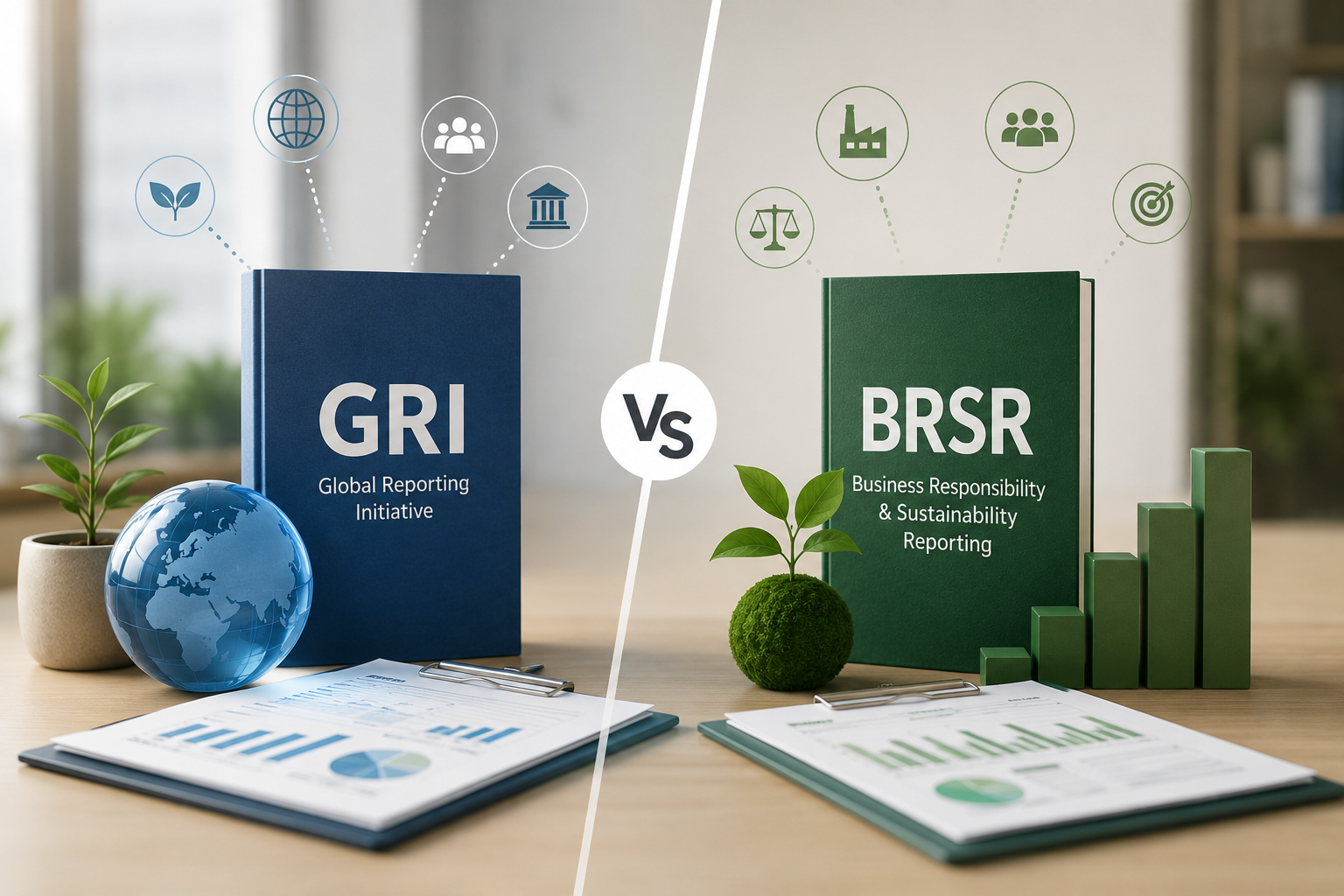
GRI vs BRSR
Reconciling Two Reporting Standards Without Duplicating Work
Reading Time
5 min
Article Sections
6
Share Links
3
On This Page
Article Section
Introduction
Many Indian companies now report against two different sustainability frameworks at once. The Global Reporting Initiative (GRI) standards are the world's most widely used voluntary sustainability reporting framework, while the Business Responsibility and Sustainability Report (BRSR) is SEBI's mandatory disclosure format for India's top listed companies. Teams often end up collecting nearly identical emissions, workforce, and governance data twice, once for each report.
This duplication wastes time, increases the risk of inconsistent numbers between the two disclosures, and pulls sustainability teams away from higher-value analysis. Reconciling GRI and BRSR properly means building one shared data set that satisfies both frameworks instead of running two parallel reporting processes.
This guide walks through how to map GRI Standards to BRSR principles and indicators, identify which data points can be reused directly, and set up a single collection workflow that keeps both reports accurate without duplicating effort.
Article Section
What Should You Know Before Reconciling GRI and BRSR?
GRI and BRSR cover overlapping ground. Both frameworks ask companies to disclose emissions, energy use, workforce diversity, health and safety, and board governance practices. Where they differ is structure and legal status: GRI is a modular, topic-based voluntary standard used globally, while BRSR is a fixed, principle-based format mandated by SEBI for the top 1,000 listed companies in India.
Before starting reconciliation, pull together your most recent GRI content index (if you report under GRI) and your last BRSR filing. You will also need a simple cross-mapping matrix, a spreadsheet listing each GRI Standard alongside the BRSR Principle or Essential Indicator it corresponds to, plus a named owner for each data point so responsibility for collection is clear.
Article Section
How Do You Reconcile GRI and BRSR Without Duplicating Work?
Step 1: Build a Master Disclosure Inventory
List every disclosure currently reported under GRI and BRSR separately. Include the standard or indicator number, the topic it covers, and where the underlying data currently lives, for example your HR system for workforce numbers or your EHS platform for emissions data. This inventory becomes the foundation for spotting overlap.
Step 2: Map GRI Standards to BRSR Principles
Match each GRI Standard to the BRSR Principle or Essential Indicator that covers the same topic. GRI 305 on emissions, for instance, maps closely to BRSR Principle 6 on environmental protection. Most mappings are not exact one-to-one matches, so note where definitions or boundaries diverge as you go.
Step 3: Separate Shared Data Points From Divergent Ones
Mark which metrics can be reported identically in both frameworks and which need adjustment. BRSR often asks for India-specific detail, such as value chain disclosures or related party transactions, that GRI does not require in the same form. These divergent points need their own collection step.
Step 4: Set Up One Shared Data Collection Workflow
Route all overlapping data through a single collection process rather than two. Tag each entry with its corresponding GRI Standard and BRSR indicator reference so both reports can pull from the same source without a second round of data gathering.
Step 5: Reconcile Definitions, Boundaries and Units Before Publishing
Check that reporting boundaries match. GRI may ask for value chain-wide figures while BRSR sometimes limits scope to the reporting entity. Where boundaries genuinely differ, disclose the difference clearly in both reports rather than forcing a false match.
Article Section
What Mistakes Should You Avoid When Reconciling GRI and BRSR?
Assuming Every Indicator Has a One-to-One Match
Not every GRI Standard maps cleanly onto a BRSR indicator. Some require partial rework rather than a straight copy. Treat the mapping matrix as a living document, not a one-time exercise.
Splitting Ownership Across Teams
When two teams collect the same metric independently, small definitional differences creep in. Assign single ownership for each shared data point so there is one number, not two versions of the same figure.
Ignoring Framework Updates
Both GRI and BRSR revise their requirements periodically, and SEBI has expanded BRSR to include value chain and assurance requirements in recent cycles. Review your mapping matrix whenever either framework updates its disclosure list.
What to Do When No GRI Equivalent Exists
Some BRSR indicators, particularly those tied to Indian regulation, have no direct GRI counterpart. Report these separately rather than forcing them into the shared workflow, and flag them clearly in your disclosure inventory.
Article Section
Conclusion
Reconciling GRI and BRSR comes down to two things: a shared disclosure inventory and a mapping matrix that stays current as both frameworks evolve. Once overlapping data points are identified, most of the reporting burden disappears, leaving only the India-specific disclosures that genuinely need separate handling.
Start with your highest-overlap topics, emissions, workforce, and governance, before tackling the smaller BRSR-specific requirements. A well-maintained mapping matrix turns two reporting cycles into one connected process.
Article Section
Frequently Asked Questions
What is the main difference between GRI and BRSR?
GRI is a voluntary global sustainability standard, while BRSR is SEBI's mandatory disclosure format for India's top listed companies.
Can a company report under both GRI and BRSR at the same time?
Yes, many Indian companies report under both, and mapping overlapping indicators avoids collecting the same data twice.
Which BRSR indicators typically have no GRI equivalent?
India-specific disclosures such as value chain details and related party transactions often lack a direct GRI counterpart.
How often should the GRI-BRSR mapping matrix be updated?
Review it whenever either framework revises its disclosure requirements, since indicator definitions can shift between cycles.
Who should own the reconciliation process internally?
A single sustainability or ESG reporting lead should own the mapping matrix so ownership of shared data stays clear.
Keep Reading
Related Blogs
All Industries
ESG and the Indian SME
Why Small Suppliers Are Suddenly Under Pressure From Their Largest Clients
Read more
All Industries
Five ESG Metrics Every Investor Pitch in India Should Now Include
Most Still Don't Know
Read more
All Industries
Carbon Credits vs Carbon Offsets
Understanding the Difference Before Making Climate Claims
Read moreNext Step
Ready to turn ESG complexity into strategic advantage?
Talk to ESG Astraa about disclosures, climate strategy, governance controls, and execution support for your team.