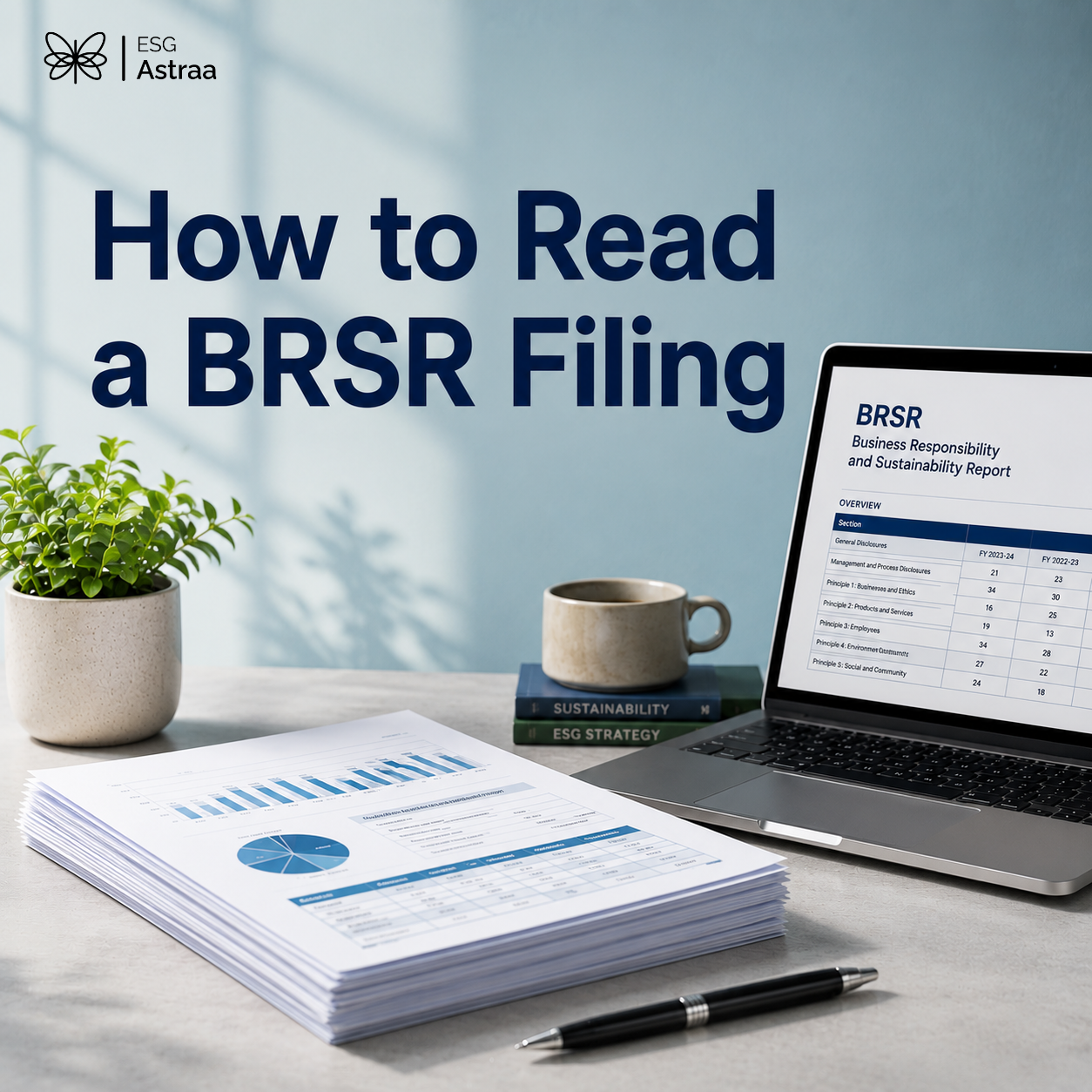
How to Read a BRSR Filing
A Practical Guide for Analysts, Investors and ESG Professionals
Reading Time
5 min
Article Sections
6
Share Links
3
On This Page
Article Section
Introduction
An analyst opens a 100-plus page BRSR filing for the first time and has no idea where to start, what to skip, or which numbers actually matter for the analysis at hand.
BRSR filings are now a primary data source for ESG-linked investment decisions, supplier due diligence, and regulatory compliance assessments, but the framework's length and structure make it easy to either skim past the substantive data or get lost in disclosure boilerplate.
This guide walks through exactly how to navigate a BRSR filing section by section, what to prioritise, and how to separate a credible disclosure from a compliance-only one.
Article Section
Before You Begin
A BRSR filing follows a fixed structure mandated by SEBI: Section A covers general company disclosures, Section B covers management and process disclosures, and Section C covers principle-wise performance across nine principles drawn from the National Guidelines on Responsible Business Conduct (NGRBC).
It helps to have a basic familiarity with the nine NGRBC principles, access to the company's filing from the prior year for comparison, and, where available, the company's standalone sustainability report for additional narrative context not captured in the structured BRSR format.
Article Section
Step-by-Step: How to Read a BRSR Filing
Step 1: Start with Section A to establish basic context
Read the general disclosures first: company details, products and services, operations footprint, and employee data. This section is quick to read and gives the scale and sector context needed to interpret everything that follows.
Step 2: Check Section B for governance and process maturity
Section B reveals whether ESG is embedded in governance, including board oversight of sustainability, policies for each of the nine principles, and whether the company has conducted a materiality assessment. A company with detailed, specific policy disclosures here is signalling more institutional maturity than one with generic, boilerplate responses.
Step 3: Move to Section C and read Essential Indicators first, principle by principle
Essential Indicators are mandatory for all companies and represent the baseline data: emissions, water usage, employee wellbeing metrics, and so on. Reading these first across all nine principles gives a complete factual picture before layering in interpretation.
Step 4: Cross-reference Leadership Indicators for the principles most relevant to your analysis
Leadership Indicators are voluntary and more detailed. A company that reports extensively on Leadership Indicators for principles relevant to its sector, such as Principle 6 on environment for a manufacturing company, is demonstrating where it has actually invested in ESG capability, not just minimum compliance.
Step 5: Check for an assurance statement and note its scope
Look for whether the filing includes an external assurance statement, and if so, whether it covers limited or reasonable assurance, and which specific indicators were assured. A filing with no assurance statement, or one covering only a narrow set of indicators, should be read with more caution than a fully assured one.
Step 6: Compare against the prior year's filing for consistency and trend
Pull the previous year's BRSR and check whether key metrics, methodologies, and reported figures are consistent. Significant unexplained shifts in a metric, or a change in calculation methodology without disclosure, are signals worth investigating further rather than taking the current year's number at face value.
Article Section
Tips, Mistakes and Troubleshooting
Use the principle-to-topic mapping to jump directly to what matters for your analysis
If you only need climate data, go straight to Principle 6; if you need labour practices, go to Principle 5. You do not need to read all nine principles in full for every use case.
Mistake: Treating Essential Indicator completion as evidence of strong ESG performance
Essential Indicators are mandatory minimums. A company filling them out completely has met a compliance bar, not necessarily demonstrated strong ESG performance; the Leadership Indicators and the assurance scope tell you more about actual maturity.
Mistake: Ignoring the narrative sections in favour of only the numerical tables
The qualitative responses, particularly around policies, grievance mechanisms, and risk identification, often reveal more about how seriously a company treats ESG than the numbers alone, since numbers can look clean even when underlying processes are weak.
Troubleshooting: What to do when figures look inconsistent or implausible
Where a reported figure seems disconnected from the company's stated scale or sector norms, check whether the assurance statement covers that specific indicator, and compare it against the company's own prior-year disclosure before drawing conclusions.
What to do after completing your review
Use your findings to benchmark the company against sector peers, flag any gaps in assurance coverage for follow-up engagement, and note where Leadership Indicator disclosure suggests genuine ESG investment versus compliance-only reporting.
Article Section
Conclusion
Reading a BRSR filing effectively is less about reading every page in order and more about knowing where the signal sits: Section A for context, Section B for governance maturity, Essential Indicators for the baseline, and Leadership Indicators and assurance scope for genuine differentiation.
Analysts and investors who apply this structured approach consistently will spend less time parsing disclosure volume and more time identifying which companies are actually building credible ESG performance versus those meeting the minimum bar.
Article Section
Frequently Asked Questions
What are the three main sections of a BRSR filing?
A BRSR filing has Section A for general company disclosures, Section B for management and process disclosures, and Section C for principle-wise performance across nine principles.
What is the difference between Essential Indicators and Leadership Indicators in BRSR?
Essential Indicators are mandatory baseline disclosures for all companies, while Leadership Indicators are voluntary and more detailed, revealing deeper ESG investment.
How can I tell if a BRSR filing has been independently assured?
Check the filing for an assurance statement specifying whether it covers limited or reasonable assurance and which indicators were included in scope.
Which BRSR principle covers a company's environmental and climate data?
Principle 6 of the NGRBC framework covers a company's environmental performance, including emissions, energy, and resource use.
Why is it important to compare a company's current BRSR filing against its prior year?
Comparing year-over-year figures helps identify unexplained shifts in metrics or undisclosed changes in calculation methodology that could signal inconsistent reporting.
Keep Reading
Related Blogs

All Industries
ESG and the Indian SME
Why Small Suppliers Are Suddenly Under Pressure From Their Largest Clients
Read more
All Industries
Five ESG Metrics Every Investor Pitch in India Should Now Include
Most Still Don't Know
Read more
All Industries
Carbon Credits vs Carbon Offsets
Understanding the Difference Before Making Climate Claims
Read moreNext Step
Ready to turn ESG complexity into strategic advantage?
Talk to ESG Astraa about disclosures, climate strategy, governance controls, and execution support for your team.