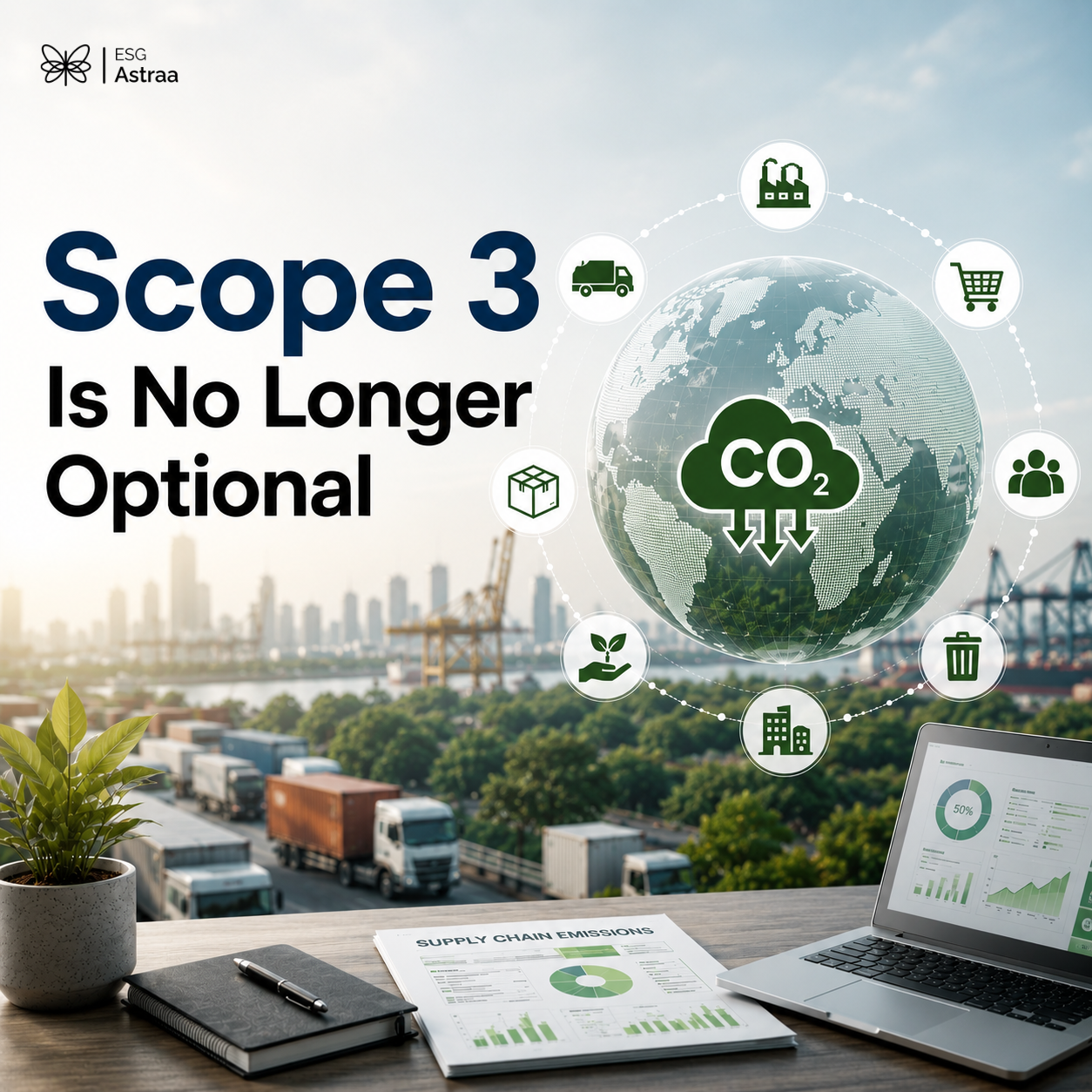
Scope 3 Is No Longer Optional
Here Is Exactly Where Indian Companies Are Getting Stuck
Reading Time
6 min
Article Sections
6
Share Links
3
On This Page
Article Section
Introduction
A year ago, Scope 3 was something Indian companies aspired to report. Today, institutional investors, export customers, and the trajectory of BRSR Core and IFRS S2 are treating it as a baseline expectation, and the companies that have not started are already behind.
The pressure is compounding from multiple directions: IFRS S2 requires Scope 3 disclosure when material, large global customers in automotive, apparel, and consumer goods are embedding supplier Scope 3 data requirements into procurement criteria, and BRSR value chain disclosure, though currently voluntary, signals the regulatory direction of travel clearly.
This article diagnoses exactly where Indian companies are getting stuck on Scope 3, why those sticking points persist, and what the companies making real progress are doing differently.
Article Section
Why Scope 3 Is Harder Than Scope 1 and 2
Unlike direct emissions or purchased energy, Scope 3 covers 15 upstream and downstream categories spanning supply chains, product use, business travel, and end-of-life treatment. For most Indian companies in manufacturing, textiles, and consumer goods, Scope 3 typically represents 70 to 90 percent of total emissions footprint.
The structural reason it is harder is that the data does not live inside the reporting company. It lives with suppliers, logistics partners, customers, and end users, most of whom have no standardised emissions reporting process, making primary data collection at scale a significant organisational and commercial challenge.
This is not unique to India; global companies at advanced stages of climate reporting still wrestle with Scope 3 data quality. What is distinctive about the Indian context is the combination of scale, supply chain complexity, and the relative immaturity of emissions reporting among tier-2 and tier-3 suppliers.
Article Section
Where Indian Companies Are Actually Getting Stuck?
Supplier data simply does not exist at the required granularity
Most Indian listed companies source from supplier networks where Scope 1 and 2 data is not measured, let alone reported in a format usable for a buyer's Scope 3 calculation. This forces companies into activity-based estimation using emission factors, which is methodologically acceptable but produces figures that are hard to verify and difficult to improve over time without supplier engagement programmes that take years to build.
Category scoping is inconsistently applied
The GHG Protocol defines 15 Scope 3 categories, and companies regularly report on the categories easiest to measure while omitting those with the largest footprint. Purchased goods and services (Category 1) and use of sold products (Category 11) are consistently the most material for Indian manufacturers but also the most data-intensive, so companies default to reporting business travel and employee commuting, which are simpler but largely immaterial.
Methodology changes between reporting cycles break comparability
Indian companies that have attempted Scope 3 disclosures over multiple years frequently switch emission factors, change category boundaries, or alter calculation approaches without adequate disclosure of the change. This makes year-on-year trend analysis meaningless and creates credibility problems during assurance or investor engagement when the methodology cannot be consistently explained.
No one owns the Scope 3 exercise internally
Scope 3 requires coordinated input from procurement, logistics, sales, HR, and finance, none of whom typically sit within the sustainability function. In most companies, this coordination gap means the exercise either stalls at data collection or lands entirely on the sustainability team, which lacks the purchasing leverage to compel suppliers to engage or the authority to restructure product design decisions that affect downstream emissions.
Article Section
What Companies Making Progress Are Doing Differently?
Starting with a screening assessment to prioritise material categories
Rather than attempting all 15 categories simultaneously, companies making progress begin with a Scope 3 screening, using spend data, physical activity data, and sector-level emission factors to identify which two or three categories represent the majority of their footprint, then focus resources there first.
Assigning cross-functional ownership before touching the data
The companies that have moved furthest on Scope 3 resolved the governance question before the data question: naming a senior owner in procurement or operations for upstream categories, and in sales or product for downstream categories, rather than leaving it with a sustainability team that has no authority over the relevant data sources.
Treating documented estimates as a legitimate starting point
Companies that have produced consistent, well-documented Scope 3 figures using activity-based methods and published emission factors, with clear assumptions and boundary definitions, are in a stronger position than those still waiting for primary supplier data before disclosing anything. A defensible estimate with a disclosed methodology is a starting point; silence is not.
Building supplier data capability as a medium-term investment
The companies beginning to close the Scope 3 data gap are investing in supplier onboarding programmes, embedding emissions data requests into procurement contracts, and in some cases sharing tools and training with key suppliers to raise baseline reporting capability across their tier-1 network.
Article Section
Conclusion
The Scope 3 challenge is fundamentally a governance and organisational challenge that happens to have a data problem attached to it. Companies that frame it only as a measurement exercise will keep hitting the same walls: unresponsive suppliers, siloed functions, and figures that cannot survive scrutiny.
The companies that will close this gap are those that treat Scope 3 as a supply chain management question as much as a reporting one, assigning real accountability, starting with documented estimates, and building supplier capability in parallel. The timeline for doing this quietly, before investors and customers start asking, is narrowing.
Article Section
Frequently Asked Questions
What are the 15 Scope 3 categories under the GHG Protocol and which are most material for Indian companies?
The GHG Protocol defines 15 upstream and downstream Scope 3 categories, and for most Indian manufacturers the most material are Category 1 (purchased goods and services) and Category 11 (use of sold products).
Is Scope 3 disclosure currently mandatory under BRSR or IFRS S2?
Under BRSR, value chain disclosure including Scope 3 is currently voluntary following SEBI's March 2025 circular, while IFRS S2 requires Scope 3 disclosure when it is material to the company's climate-related risks and opportunities.
What is the difference between activity-based and spend-based methods for calculating Scope 3 emissions?
Activity-based methods use physical activity data such as tonnes of material purchased multiplied by emission factors, while spend-based methods use financial spend data multiplied by sector-level emission intensity factors, with activity-based generally producing more accurate results.
How should a company prioritise which Scope 3 categories to measure first?
Companies should begin with a screening assessment using spend or activity data to identify the two or three categories that represent the majority of their total Scope 3 footprint and focus measurement resources there first.
What should a company disclose if it cannot yet calculate all Scope 3 categories accurately?
Companies should disclose the categories they have calculated, clearly document the methodology and assumptions used, identify which categories are excluded and why, and commit to expanding scope in future reporting cycles.
Keep Reading
Related Blogs
All Industries
ESG and the Indian SME
Why Small Suppliers Are Suddenly Under Pressure From Their Largest Clients
Read more
All Industries
Five ESG Metrics Every Investor Pitch in India Should Now Include
Most Still Don't Know
Read more
All Industries
Carbon Credits vs Carbon Offsets
Understanding the Difference Before Making Climate Claims
Read moreNext Step
Ready to turn ESG complexity into strategic advantage?
Talk to ESG Astraa about disclosures, climate strategy, governance controls, and execution support for your team.