Why Your Supplier's ESG Score Now Affects Yours
Article 1 min read
BRSR value chain disclosure explained, and why it matters even while it is voluntary.
By ESG Astraa Advisory Team
In brief
ESG reporting under BRSR was once mainly about what happens inside a company's own operations. That scope is widening. What a company's suppliers do, and how they manage emissions, water, waste and labour, is increasingly part of that company's own ESG story, whether or not it appears as a mandatory disclosure line.
- A value chain partner individually accounts for 2% or more of purchases or sales. Companies may limit disclosure to partners covering 75%.
- 2% · 75%
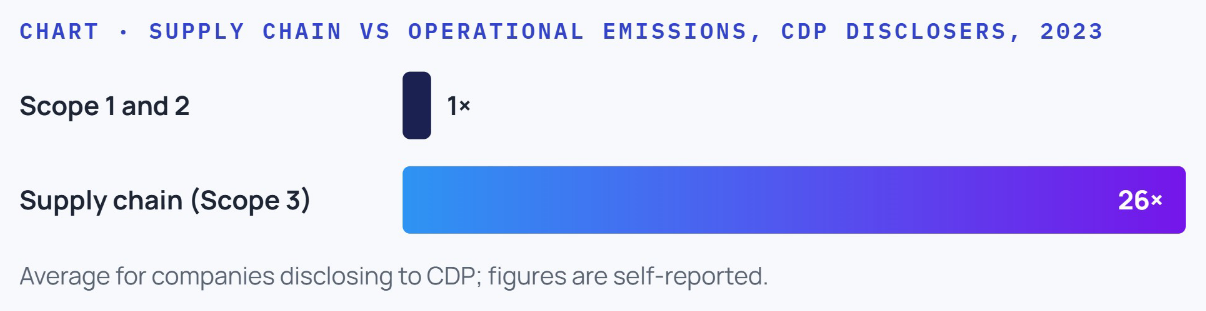
- Supplier emissions still flow into Scope 3, which averaged 26 times operational emissions for companies disclosing to CDP.
- 26×
- buyers requesting data
- 250+
In this article
The scope of ESG reporting is widening
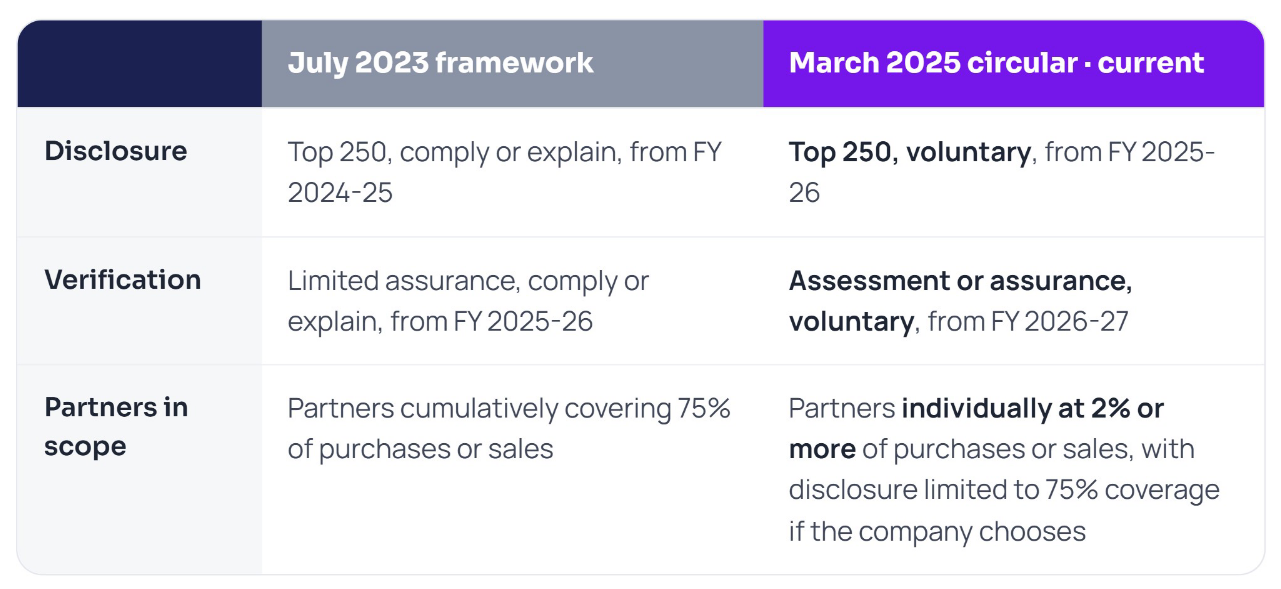
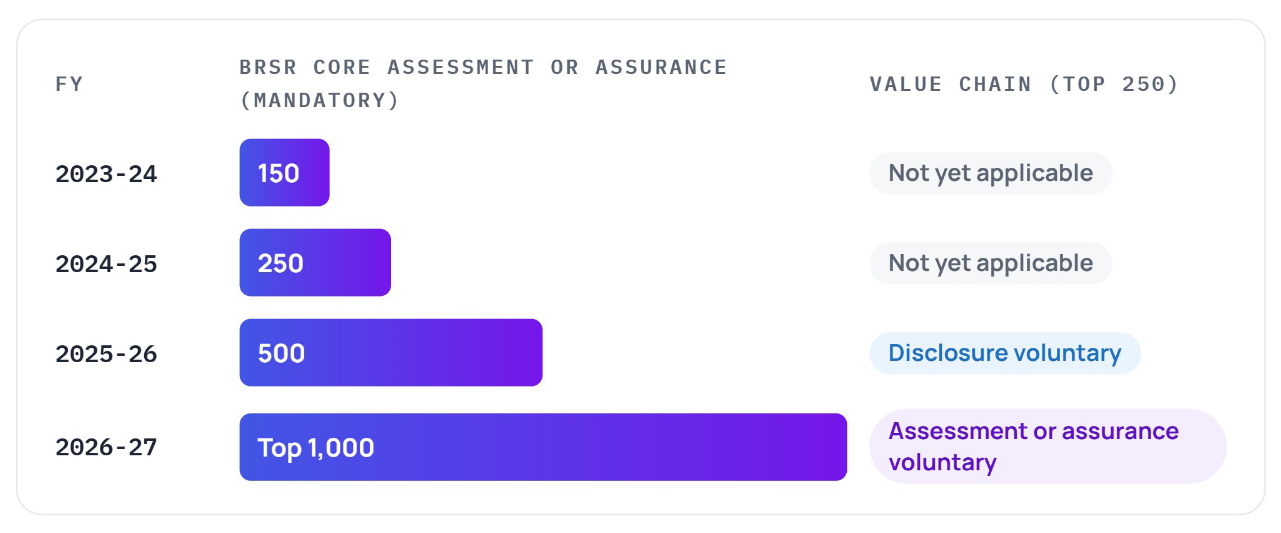
The top 1,000 listed companies by market capitalisation have reported under BRSR since FY 2022-23, and BRSR Core, the independently verified subset, phased in from the top 150 and reaches the top 1,000 in FY 2026-27. Value chain disclosure was designed to carry this logic outward to significant partners, but SEBI's March 2025 circular made that layer voluntary and gave it an extra year.
What BRSR value chain disclosure actually says
BRSR Core is a subset of BRSR with key indicators under nine ESG attributes, including greenhouse gas emissions, water, waste and employee wellbeing. Value chain disclosure means the listed company reports BRSR Core indicators for its top upstream and downstream partners, as part of its annual report.
Exhibit 1
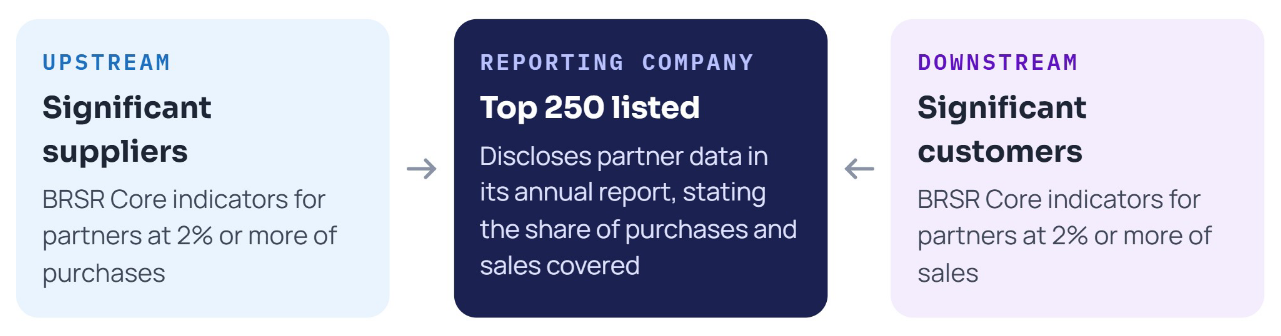
Exhibit 2
View the data
| July 2023 framework | March 2025 circular · current | |
|---|---|---|
| Disclosure | Top 250, comply or explain, from FY 2024-25 | Top 250, voluntary, from FY 2025-26 |
| Verification | Limited assurance, comply or explain, from FY 2025-26 | Assessment or assurance, voluntary, from FY 2026-27 |
| Partners in scope | Partners cumulatively covering 75% of purchases or sales | Partners individually at 2% or more of purchases or sales, with disclosure limited to 75% coverage if the company chooses |
A defined threshold, not every vendor
A company that does disclose must also state the share of its total purchases and sales covered by the partners it reports on.
Exhibit 3
View the data
| FY | BRSR CORE ASSESSMENT OR ASSURANCE (MANDATORY) | VALUE CHAIN (TOP 250) |
|---|---|---|
| 2023-24 | 150 | Not yet applicable |
| 2024-25 | 250 | Not yet applicable |
| 2025-26 | 500 | Disclosure voluntary |
| 2026-27 | Top 1,000 | Assessment or assurance voluntary |
Why supplier ESG performance still affects your score
Even where value chain BRSR reporting is voluntary, Scope 3 emissions are increasingly expected in climate disclosures, investor questionnaires and frameworks such as the GHG Protocol. A supplier with poor emissions data or carbon-intensive processes inflates a reporting company's own Scope 3 number.
Exhibit 4
View the data
| Category | Multiple |
|---|---|
| Scope 1 and 2 | 1× |
| Supply chain (Scope 3) | 26× |
What this means for your business
Identify which suppliers and customers meet or approach the 2% purchase or sales threshold. These are the partners most likely to be in scope if requirements expand.
- 101 Start mapping significant value chain partners now
- 202 Build supplier ESG data collection into procurement
- 303 Keep voluntary and assessed disclosures clearly separate
- 404 Note the green credits indicator
- 505 If you are a supplier, expect data requests
The regulatory line and the business reality have diverged
BRSR value chain disclosure may be voluntary under current SEBI rules, but the influence of supplier ESG performance on a company's own climate numbers, investor relationships and reputation is not optional in practice. Companies that only track the regulatory line are missing the business reality.
Frequently asked questions
- Is BRSR value chain disclosure mandatory for companies in India?
- No, SEBI's circular of 28 March 2025 made BRSR value chain disclosure voluntary for the top 250 listed companies from FY 2025-26, and its assessment or assurance voluntary from FY 2026-27.
- Who counts as a significant value chain partner under BRSR?
- A significant value chain partner is an upstream supplier or downstream customer individually accounting for 2% or more of the listed company's purchases or sales by value.
- Why does supplier ESG performance affect a company if disclosure is voluntary?
- Supplier emissions directly feed into Scope 3 carbon metrics, which average 26 times operational emissions for CDP disclosers, while customers, investors, and procurement contracts increasingly demand supply chain data regardless of regulatory lines.
Where ESG Astraa can help



About the author
ESG Astraa Advisory Team. ESG Astraa helps Indian companies collect ESG data, calculate emissions and file BRSR and other disclosures, with advisors alongside the software.