Myth vs Fact: Is AI Really Bad for the Environment?
Article 1 min read
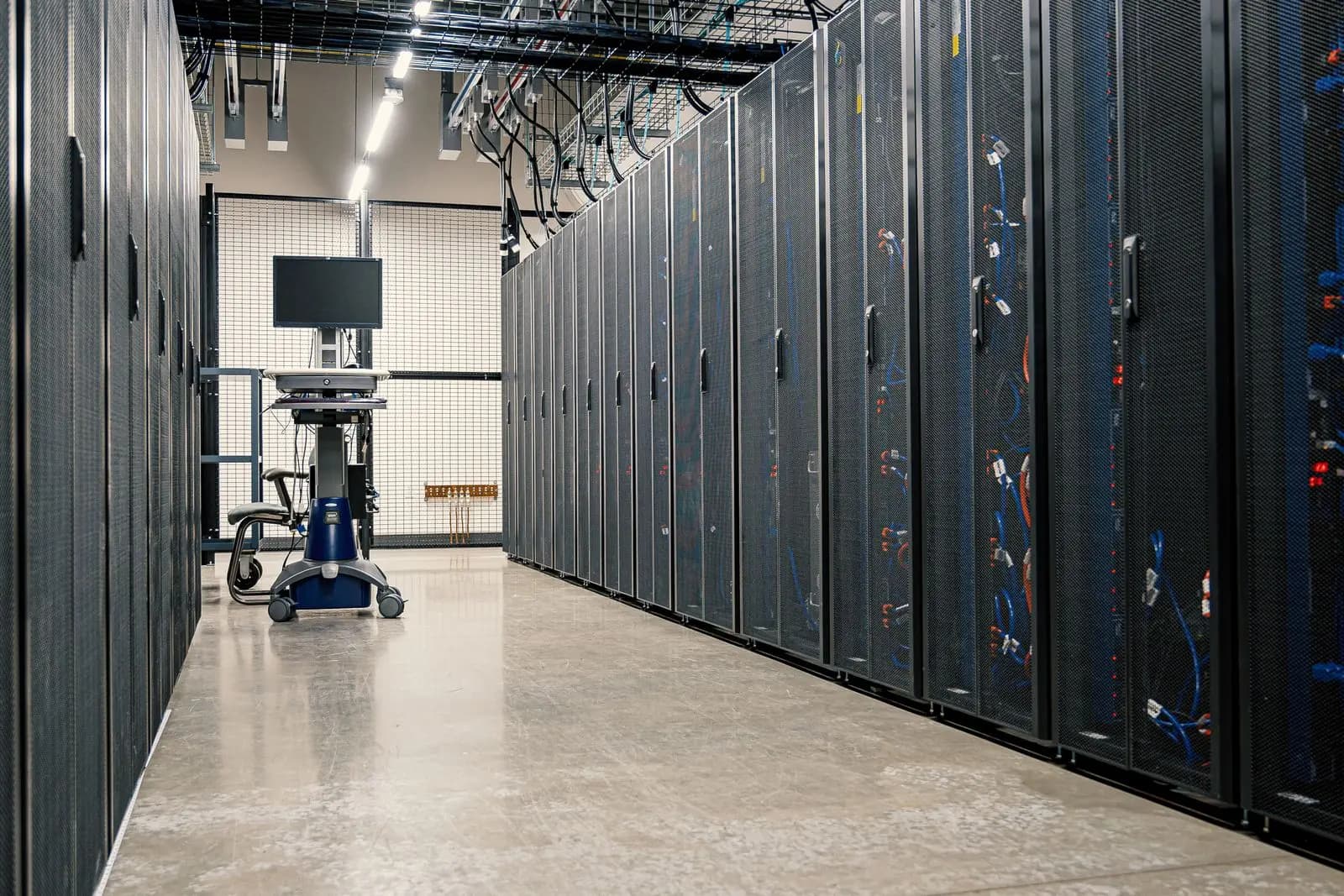
A data centre corridor lined with rows of black server racks. Photo: Brett Sayles, Pexels License, cropped.
Separating real AI environmental impacts from exaggerations and wishful thinking.
By ESG Astraa Advisory Team
In brief
Is AI wrecking the climate, or is its footprint too small to matter? Both claims circulate widely, and both are easy to support with a number from somewhere.
- Data centres' share of global electricity, 2024 to a 2030 projection
- 1.5% → 3%
- Rise in data centre electricity use in 2025 (IEA, April 2026)
- +17%
- Growth of AI-focused data centres in the same year
- +50%
In this article
01 · BOUNDARIES
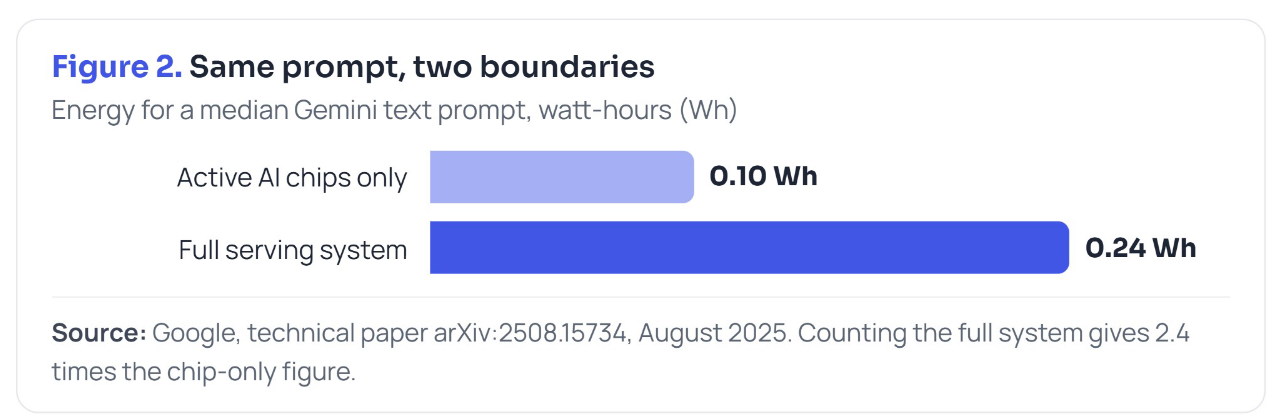
AI's footprint has several parts. Training builds a model, and inference runs it each time someone uses it. Impacts also fall in two places.
Exhibit 1
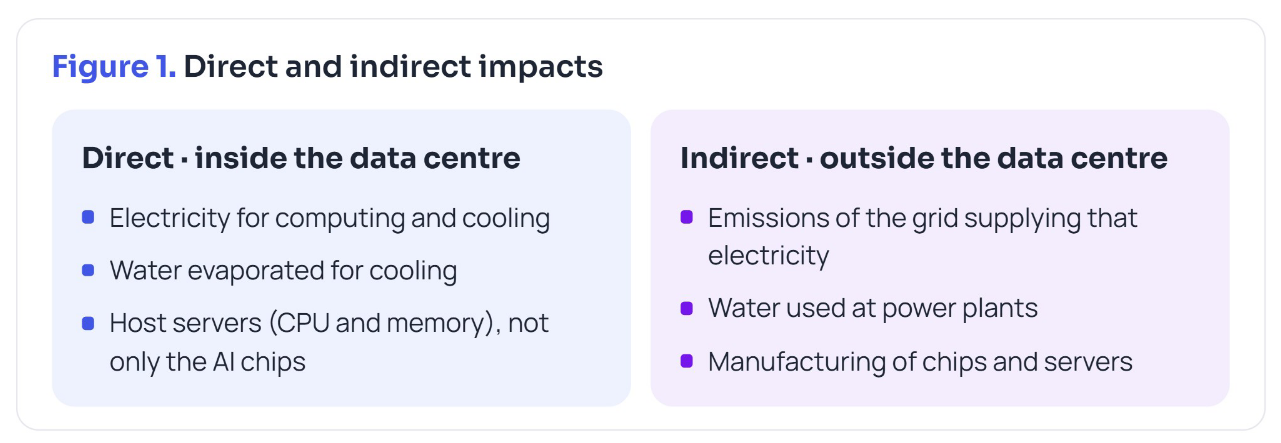
Exhibit 2
View the data
| Boundary | Energy (Wh) |
|---|---|
| Active AI chips only | 0.10 Wh |
| Full serving system | 0.24 Wh |
02 · OVERVIEW
Each myth has a verdict. None of the four is simply true, and none is simply false.
MYTH 1
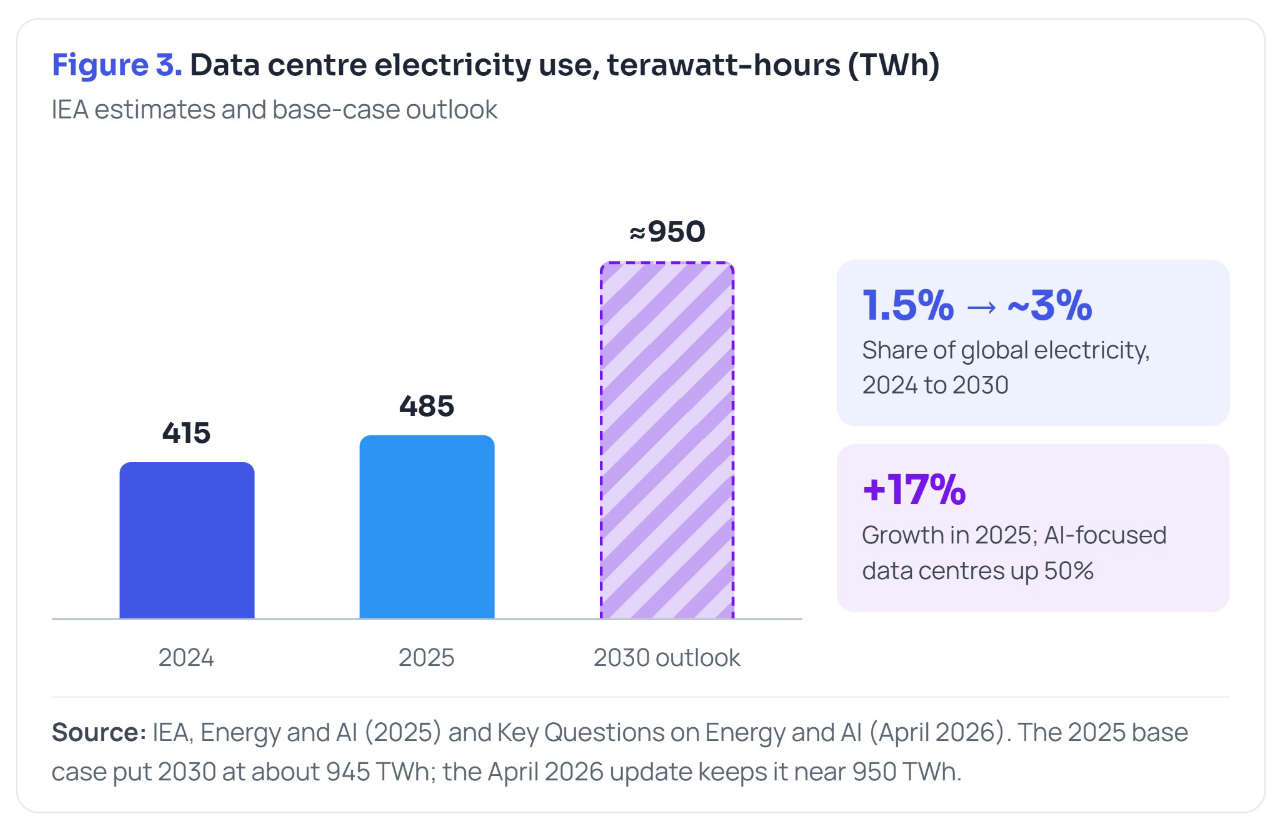
Why people believe it. Headlines about gigawatt campuses and rising power demand suggest AI is reshaping global energy use.
Exhibit 3
View the data
| Year | Electricity use (TWh) |
|---|---|
| 2024 | 415 |
| 2025 | 485 |
| 2030 outlook | ≈950 |
MYTH 2
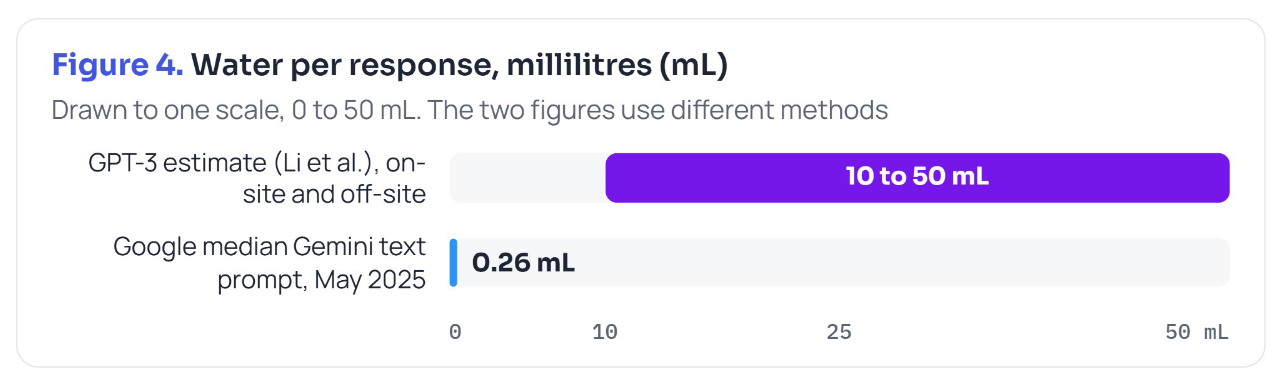
Why people believe it. Early academic estimates for large models were high. One widely cited study estimated that GPT-3 used a 500 mL bottle of water for roughly 10 to 50 medium-length responses, counting both on-site and off-site water.
Exhibit 4
View the data
| Estimate | Water per response (mL) |
|---|---|
| GPT-3 estimate (Li et al.), on-site and off-site | 10 to 50 mL |
| Google median Gemini text prompt, May 2025 | 0.26 mL |
MYTH 3
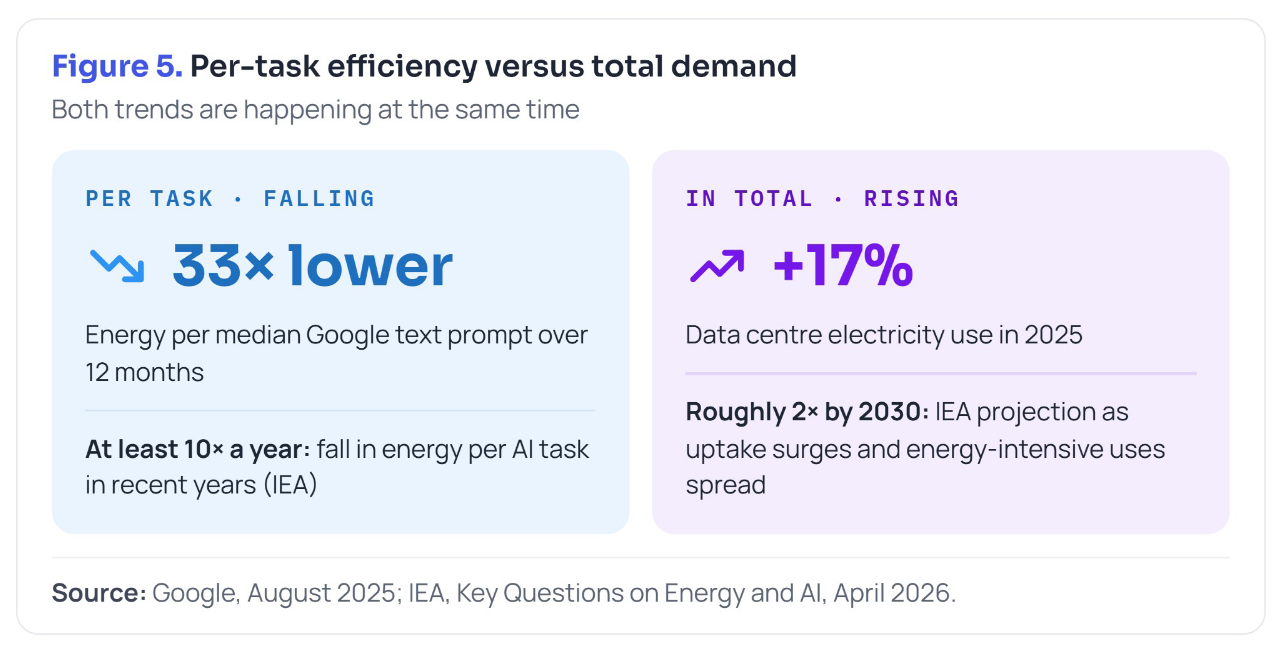
Why people believe it. Companies report large per-task gains, which suggests total impact must fall.
Exhibit 5
MYTH 4
Why people believe it. AI is used in grid planning, building controls and industrial optimisation, so savings seem automatic.
Exhibit 6
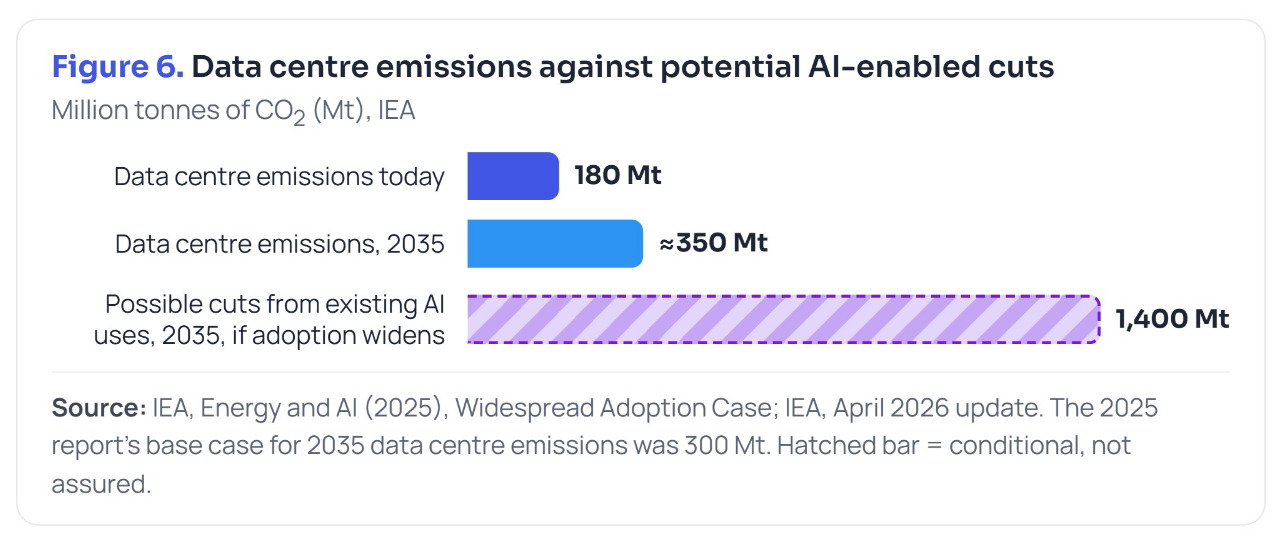
View the data
| Category | Million tonnes of CO2 (Mt) |
|---|---|
| Data centre emissions today | 180 Mt |
| Data centre emissions, 2035 | ≈350 Mt |
| Possible cuts from existing AI uses, 2035, if adoption widens | 1,400 Mt |
03 · BROADER LESSONS
- 101 Ask what is being measured
- 202 Match the model to the task
- 303 Check the power source and location
- 404 Treat savings as a hypothesis
- 505 Ask for disclosure
CONCLUSION
The evidence supports neither alarm nor dismissal. AI's electricity use is small globally but growing fast and concentrated locally, per-prompt figures depend on method, efficiency gains do not guarantee lower totals, and emission savings have to be earned.
Frequently asked questions
- How much electricity does AI and data centre infrastructure consume?
- Data centres used about 415 TWh in 2024 (roughly 1.5% of global electricity) and rose 17% to 485 TWh in 2025, with IEA projections reaching about 950 TWh or 3% of global electricity by 2030.
- How much water does a typical AI prompt use?
- Google reported approximately 0.26 mL of cooling water for a median Gemini text prompt, whereas earlier studies of larger models like GPT-3 estimated 10 to 50 mL when factoring in off-site power generation water.
- Can AI reduce more carbon emissions than it produces?
- While AI applications could theoretically enable up to 1,400 Mt of emission cuts by 2035 compared to 350 Mt of data centre emissions, the IEA notes these savings depend heavily on widespread deliberate adoption and are not guaranteed.
Where ESG Astraa can help


About the author
ESG Astraa Advisory Team. ESG Astraa helps Indian companies collect ESG data, calculate emissions and file BRSR and other disclosures, with advisors alongside the software.
References
- IEA, Energy and AI: Energy demand from AI iea.org
- IEA, Artificial intelligence topic page iea.org
- IEA, Energy and AI: AI and climate change iea.org
- Reglobal, Energy for AI: summary of the IEA report reglobal.org
- IEA, Key Questions on Energy and AI: Executive summary, 16 April 2026 iea.org
- Euronews, 11 April 2025, reporting the IEA's conclusions on AI and emissions euronews.com
- Google, How much energy does Google's AI use? We did the math, August 2025 (via techUK); technical paper arXiv:2508.15734 techuk.org
- DatacenterDynamics, Google median Gemini prompt uses 0.24 watt-hours of power and consumes 0.26 ml of water datacenterdynamics.com
- Li, Yang, Islam and Ren, Making AI Less Thirsty: Uncovering and Addressing the Secret Water Footprint of AI Models, arXiv:2304.03271 arxiv.org
- CBS News, What's the environmental cost of an AI text prompt? Google says it has an answer cbsnews.com
- Transition Economics Institute, IEA Says Data Centre Electricity Use Rose 17% in 2025 tei-energy.org