CCTS and CBAM: Will India's Carbon Market Cut Exporters' EU Liability?
Article 1 min read
What the EU's Article 9 rules mean for Indian exporters, and why to prepare for both regimes independently.
By ESG Astraa Advisory Team
In brief
It is tempting to assume that once India has its own carbon market, exporters can simply deduct what they have paid at home from what they owe at the EU border. The reality is more conditional than that.
- EU imports of iron and steel from India in 2024
- €3.9 bn
- fall in India's steel and aluminium exports to the EU
- −24.4%
In this article
- What CBAM actually requires
- Two numbers set the size of the CBAM bill
- Why CCTS may not automatically qualify
- How the deduction rules took shape in 2026
- The UK contrast, kept clearly separate
- Why this matters for Indian exporters
- What exporters need to prepare
- A live regulatory question, not a settled one
- Frequently asked questions
What CBAM actually requires
CBAM is the EU's carbon price on imported goods, set up under Regulation (EU) 2023/956. It covers six sectors.
Exhibit 1
TIMELINE · THE DEFINITIVE REGIME
1 Jan 2026
Definitive regime begins.
1 Feb 2027
CBAM certificate sales open.
30 Sep 2027
First annual declaration due, covering 2026 imports.
ESG Astraa
Exhibit 2
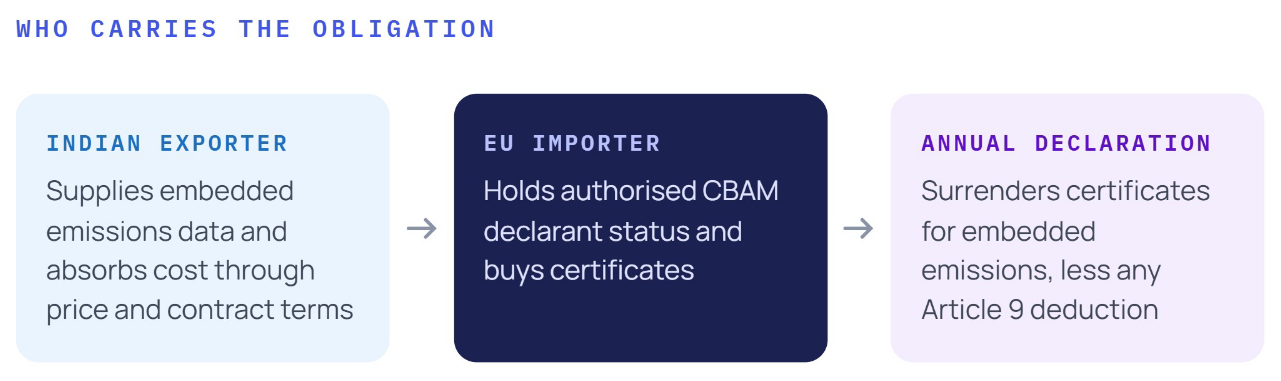
Two numbers set the size of the CBAM bill
The bill an EU importer pays depends on the price of a CBAM certificate and on how much of the EU's own free allocation is still credited against embedded emissions. Both are moving against exporters.
Exhibit 3
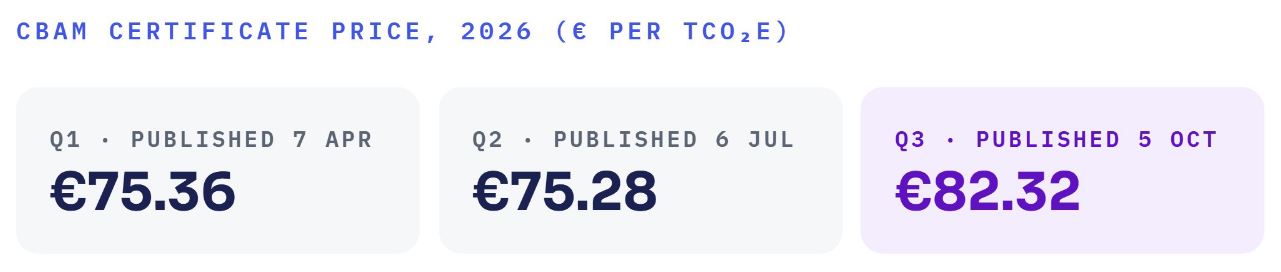
View the data
| Q1 · PUBLISHED 7 APR | Q2 · PUBLISHED 6 JUL | Q3 · PUBLISHED 5 OCT |
|---|---|---|
| €75.36 | €75.28 | €82.32 |
Exhibit 4
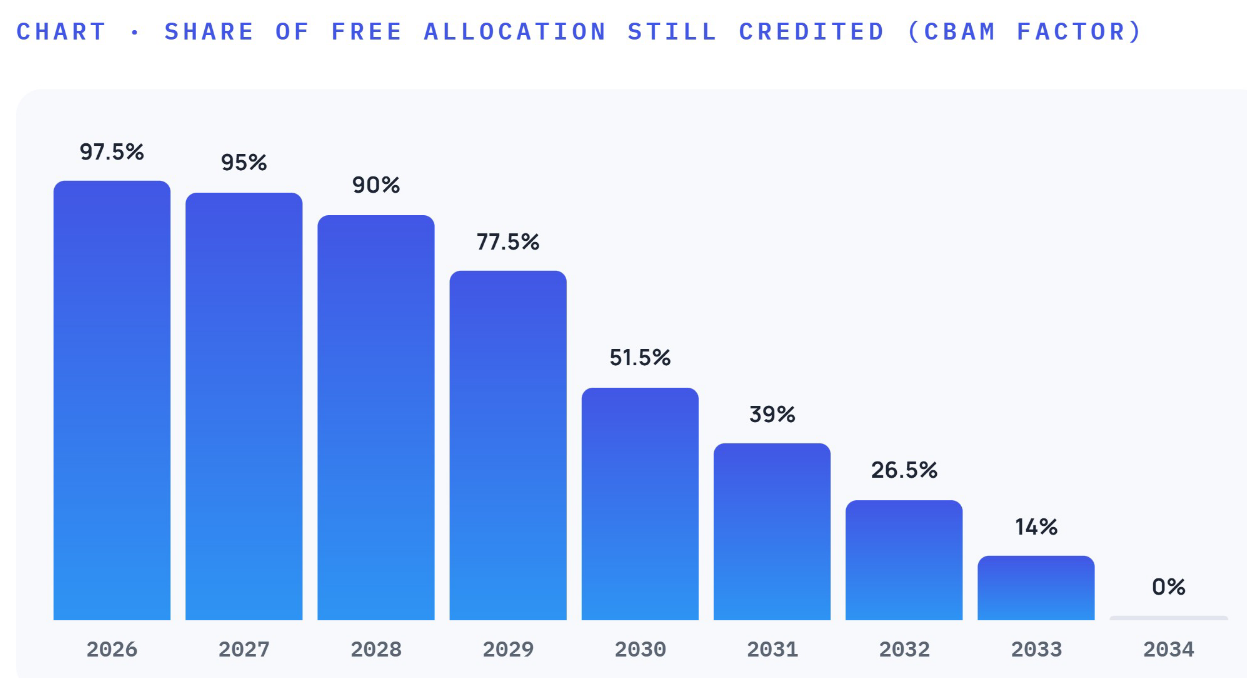
View the data
| Year | Share of free allocation |
|---|---|
| 2026 | 97.5% |
| 2027 | 95% |
| 2028 | 90% |
| 2029 | 77.5% |
| 2030 | 51.5% |
| 2031 | 39% |
| 2032 | 26.5% |
| 2033 | 14% |
| 2034 | 0% |
Why CCTS may not automatically qualify
Article 9 asks whether a scheme reflects a genuine, binding, non-discriminatory carbon price. CCTS works on a baseline-and-credit logic: entities earn tradable certificates for beating an intensity target, rather than paying a straightforward price per tonne.
Exhibit 5
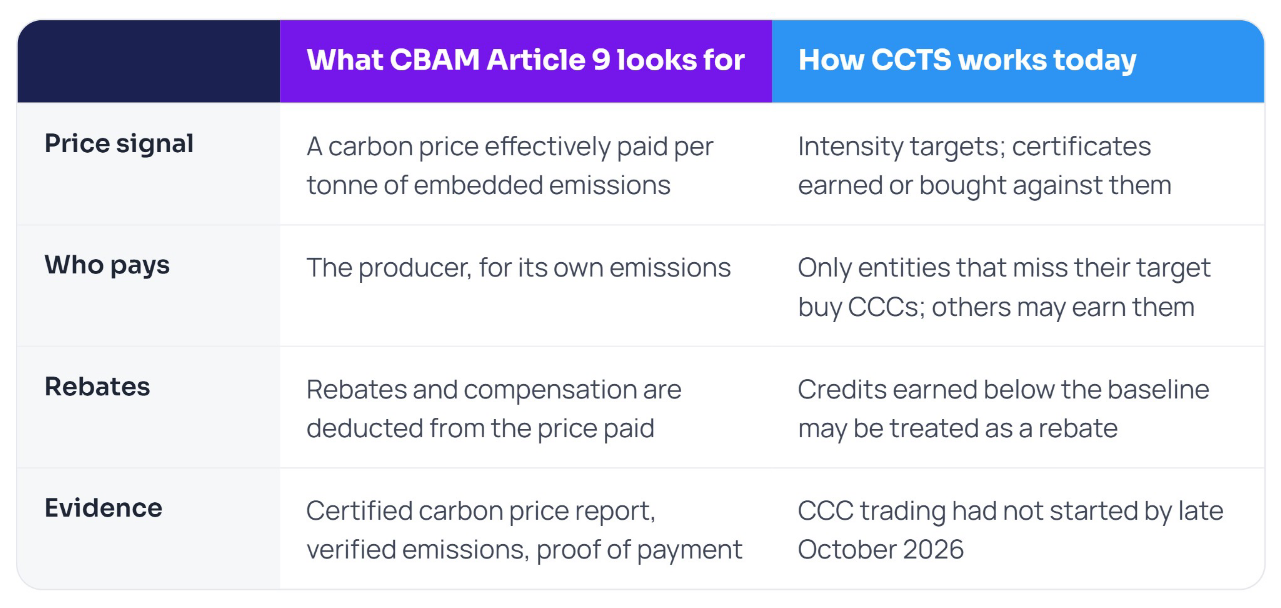
View the data
| Dimension | What CBAM Article 9 looks for | How CCTS works today |
|---|---|---|
| Price signal | A carbon price effectively paid per tonne of embedded emissions | Intensity targets; certificates earned or bought against them |
| Who pays | The producer, for its own emissions | Only entities that miss their target buy CCCs; others may earn them |
| Rebates | Rebates and compensation are deducted from the price paid | Credits earned below the baseline may be treated as a rebate |
| Evidence | Certified carbon price report, verified emissions, proof of payment | CCC trading had not started by late October 2026 |
How the deduction rules took shape in 2026
Exhibit 6
TIMELINE · ARTICLE 9 RULES
Aug 2025
Call for evidence on converting foreign carbon costs into a lower CBAM liability.
13 May 2026
Draft implementing act published, with feedback open until 10 June.
24 Sep 2026
Member-state committee reportedly gives the text no majority.
5 Nov 2026
Commission adopts the rules, per one trade report, applying from 1 January 2026. Final text not yet public.
ESG Astraa
The UK contrast, kept clearly separate
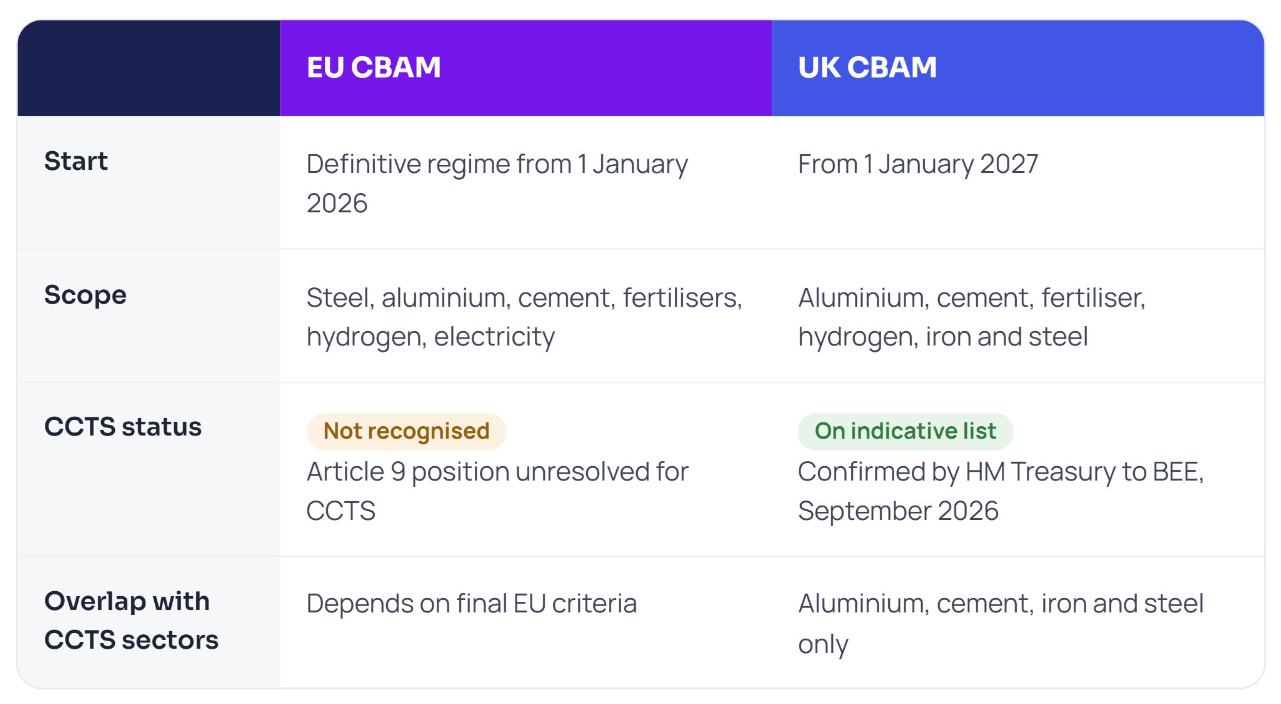
UK relief is calculated per consignment, needs evidence and verification, and depends on the actual CCTS price paid. It does not carry across to the EU.
Exhibit 7
View the data
| Dimension | EU CBAM | UK CBAM |
|---|---|---|
| Start | Definitive regime from 1 January 2026 | From 1 January 2027 |
| Scope | Steel, aluminium, cement, fertilisers, hydrogen, electricity | Aluminium, cement, fertiliser, hydrogen, iron and steel |
| CCTS status | Not recognised Article 9 position unresolved for CCTS | On indicative list Confirmed by HM Treasury to BEE, September 2026 |
| Overlap with CCTS sectors | Depends on final EU criteria | Aluminium, cement, iron and steel only |
Exhibit 8

Why this matters for Indian exporters
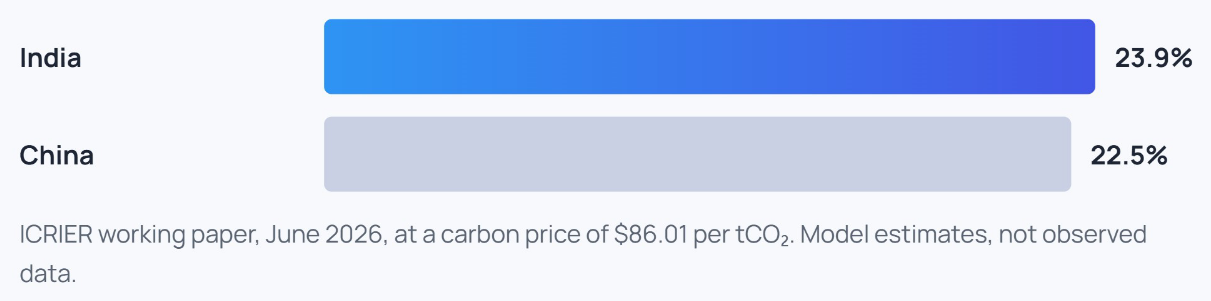
India's exposure is concentrated in steel and aluminium, the sectors where CCTS targets already apply. That makes the Article 9 outcome a material commercial question, not a technical footnote, for producers selling into Europe.
Exhibit 9
View the data
| Country | Projected Decline |
|---|---|
| India | 23.9% |
| China | 22.5% |
What exporters need to prepare
- 1Do not assume automatic deduction
- 2Track the EU's Article 9 rules closely
- 3Distinguish UK and EU CBAM explicitly
- 4Build the evidence trail regardless
- 5Watch the FTA's technical cooperation track
A live regulatory question, not a settled one
CCTS and CBAM are related but not yet linked in a way that reduces EU liability for Indian exporters. That gap deserves to be treated as an open question in planning.
Frequently asked questions
- Does compliance with India's CCTS reduce EU CBAM payments?
- No, India's CCTS has not been recognised for an Article 9 deduction under EU CBAM, meaning exporters cannot automatically offset domestic carbon compliance costs against EU liabilities.
- How does the UK CBAM treat India's CCTS compared to the EU?
- Unlike the EU, HM Treasury placed India's CCTS on an indicative list of recognised domestic schemes in September 2026, allowing consignment-level relief under the UK CBAM framework starting in 2027.
- Why does CCTS face hurdles qualifying under EU CBAM Article 9?
- CCTS operates on a baseline-and-credit model where only underperforming entities pay and outperforming facilities earn credits, which the EU draft rules may view as rebates rather than a direct, universal carbon levy.
Where ESG Astraa can help


About the author
ESG Astraa Advisory Team. ESG Astraa helps Indian companies collect ESG data, calculate emissions and file BRSR and other disclosures, with advisors alongside the software.