
What Is a GRI Content Index? Template, Requirements and Example
Article 1 min read
The traceability layer of a GRI report: what it must contain, how the template works and what a completed entry looks like.
By ESG Astraa Advisory Team
In brief
A reader wants to check one figure in a sustainability report, but nothing shows which disclosure it answers or where the supporting information sits. Data owners and assurance teams face the same problem when they try to trace a claim back to its source.
- in accordance / with reference
- 11 / 6
- reasons for omission
- 4
- Excel, with a Sector Standards version
- Free
In this article
What a GRI content index is
The content index is an overview of an organisation's reported information. It shows which GRI Standards and disclosures the organisation has used and where readers can find each one. A disclosure is a specific item of information that a GRI Standard asks an organisation to report.
Exhibit 1
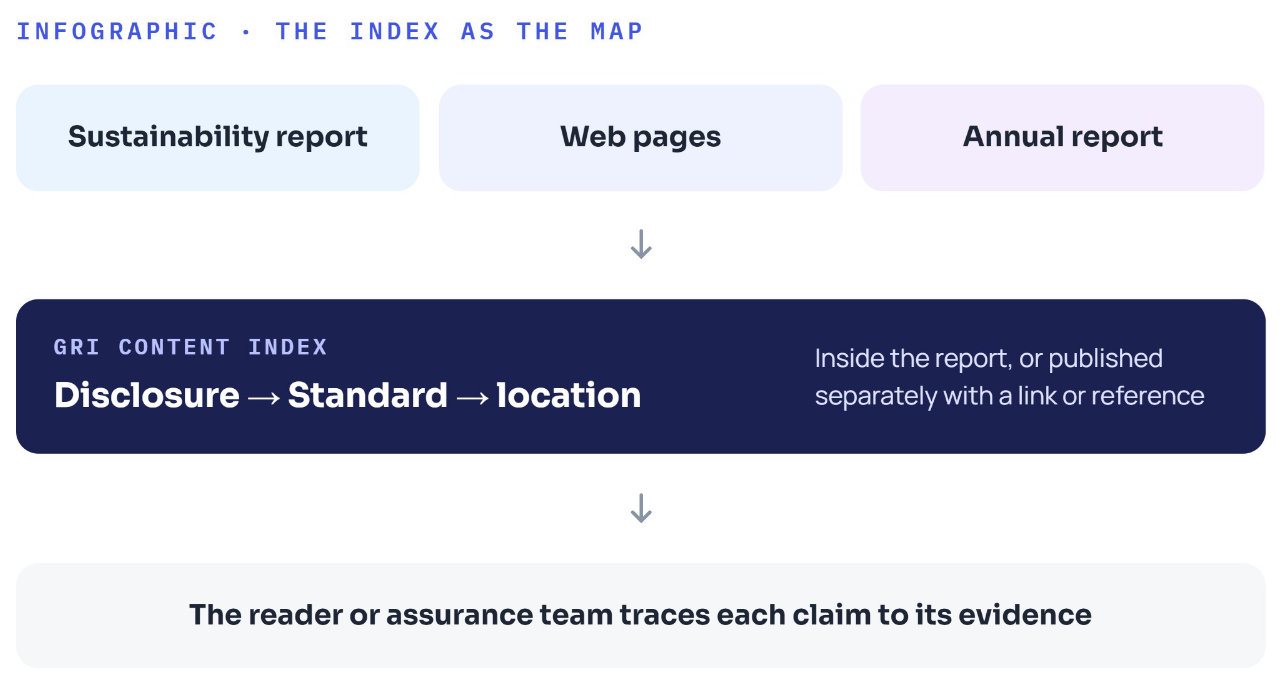
What each index must contain
GRI 1, Requirement 7, sets the list for an in accordance index. A with reference index needs a shorter list, and its statement of use has different wording, so the two claims cannot share one sentence.
Exhibit 2
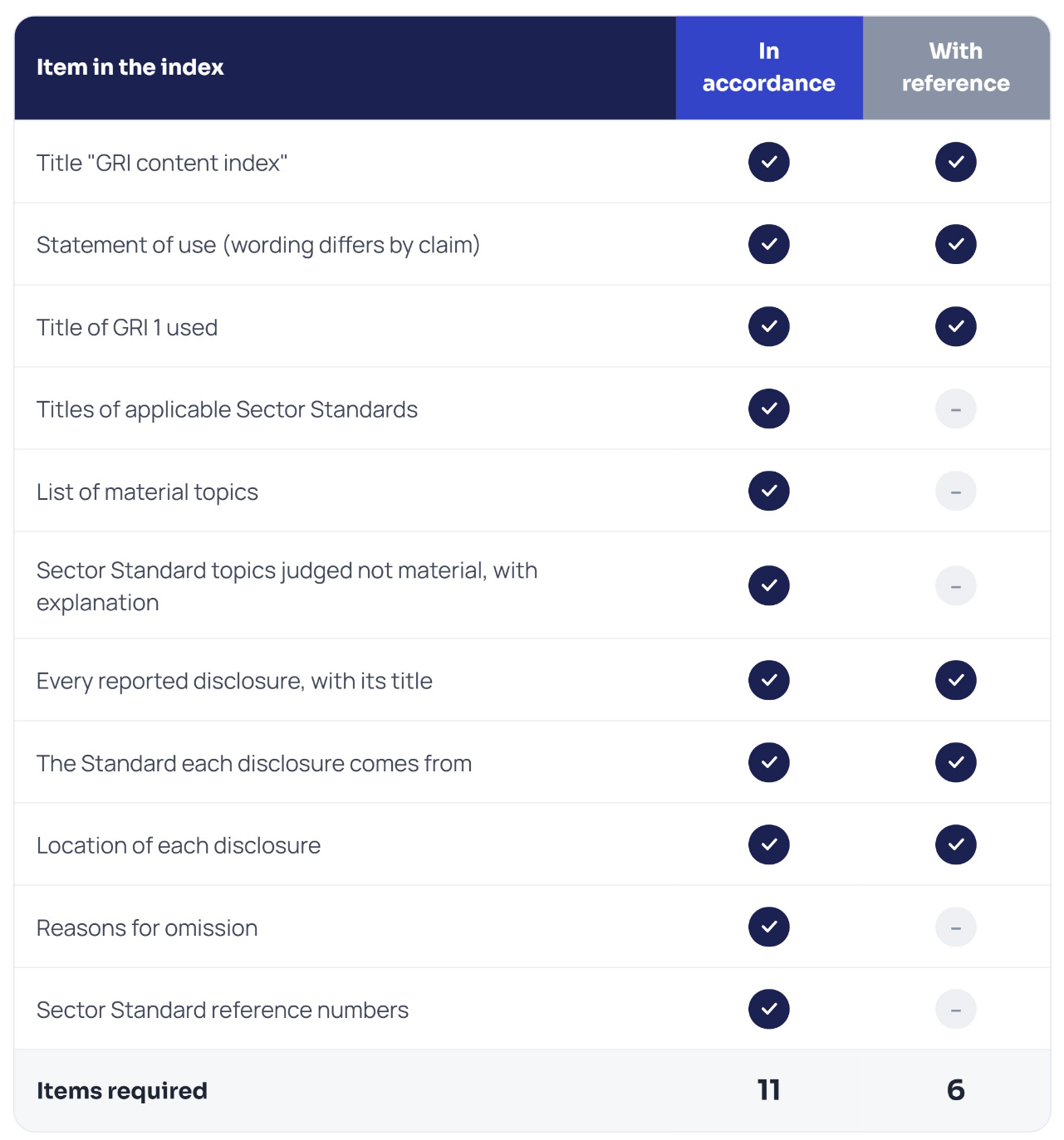
View the data
| Item in the index | In accordance | With reference |
|---|---|---|
| Title "GRI content index" | Required | Required |
| Statement of use (wording differs by claim) | Required | Required |
| Title of GRI 1 used | Required | Required |
| Titles of applicable Sector Standards | Required | – |
| List of material topics | Required | – |
| Sector Standard topics judged not material, with explanation | Required | – |
| Every reported disclosure, with its title | Required | Required |
| The Standard each disclosure comes from | Required | Required |
| Location of each disclosure | Required | Required |
| Reasons for omission | Required | – |
| Sector Standard reference numbers | Required | – |
| Items required | 11 | 6 |
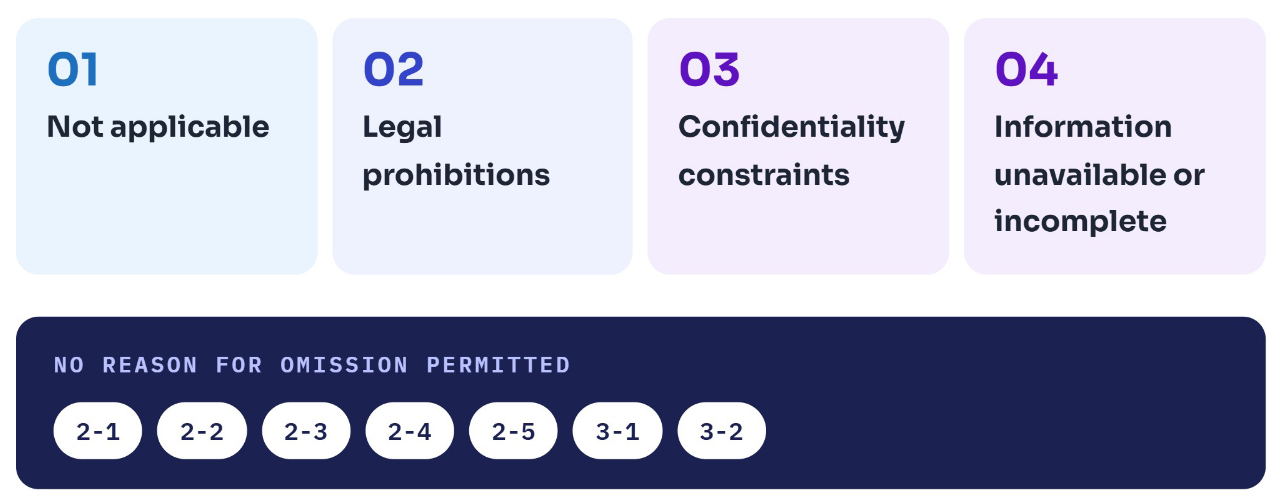
The four reasons for omission
If an organisation cannot report a disclosure or part of one, it names the omitted item, chooses one permitted reason and gives the required explanation, all inside the index.
Exhibit 3
What a completed index looks like
The statement of use comes first. It names the organisation, says it has reported in accordance with the GRI Standards, and gives the start and end dates of the reporting period. Copy the exact wording from GRI 1.
Exhibit 4
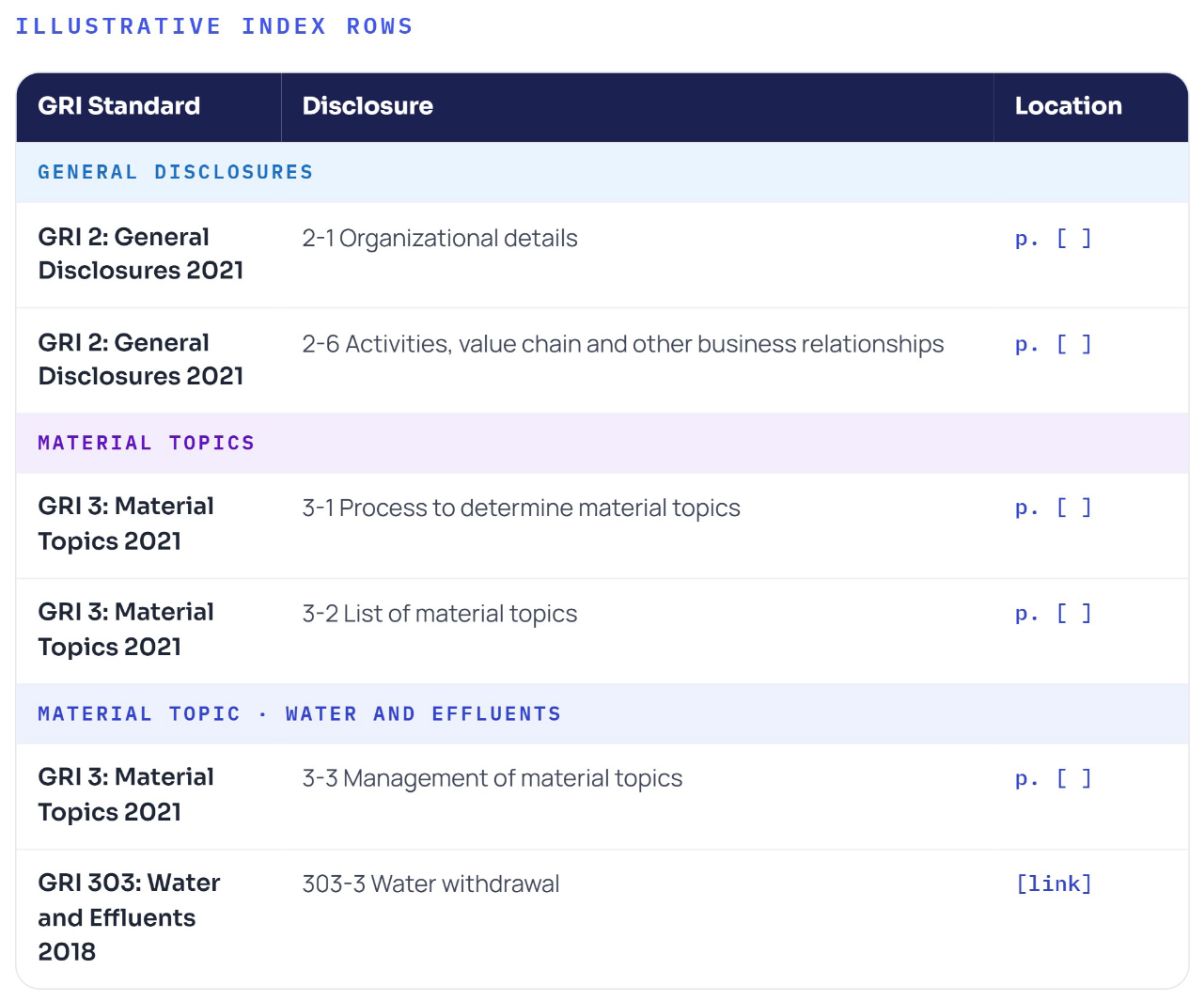
View the data
| GRI Standard | Disclosure | Location |
|---|---|---|
| GRI 2: General Disclosures 2021 | 2-1 Organizational details | p. [ ] |
| GRI 2: General Disclosures 2021 | 2-6 Activities, value chain and other business relationships | p. [ ] |
| GRI 3: Material Topics 2021 | 3-1 Process to determine material topics | p. [ ] |
| GRI 3: Material Topics 2021 | 3-2 List of material topics | p. [ ] |
| GRI 3: Material Topics 2021 | 3-3 Management of material topics | p. [ ] |
| GRI 303: Water and Effluents 2018 | 303-3 Water withdrawal | [link] |
Getting the content index right
- 1Fill the Universal Standards rows first
- 2Organise disclosures by material topic
- 3Make locations specific
- 4Use omissions sparingly
- 5Use full titles with the publication year
- 6Keep the index in step with the report
The traceability layer of a GRI report
The GRI content index is the traceability layer of a GRI report. Its required contents form a fixed list, and GRI's template gives a ready structure for it.
- 1Download the GRI template
- 2Complete the GRI 2 and GRI 3 rows
- 3Add each material topic with its disclosures
- 4Give a specific location for every row
Frequently asked questions
- What is a GRI content index?
- A GRI content index is a table that lists the specific GRI Standards and disclosures used in a sustainability report, indicating exactly where each disclosure can be found.
- Is publishing a GRI content index mandatory?
- Yes, publishing a content index is mandatory whether reporting 'in accordance with' or 'with reference to' the GRI Standards, though using the official template is optional.
- What are the permitted reasons for omission in a GRI report?
- There are only four permitted reasons: not applicable, legal prohibitions, confidentiality constraints, and information unavailable or incomplete. Certain core disclosures cannot be omitted.
Where ESG Astraa can help



About the author
ESG Astraa Advisory Team. ESG Astraa helps Indian companies collect ESG data, calculate emissions and file BRSR and other disclosures, with advisors alongside the software.