India's Green Credit Programme vs Carbon Credits
Article 1 min read
Are they the same thing?
By ESG Astraa Advisory Team
In brief
Since the Ministry of Environment, Forest and Climate Change (MoEFCC) notified the Green Credit Rules in October 2023, one question has surfaced repeatedly in boardrooms and sustainability teams across India: are Green Credits simply a domestic version of carbon credits? The answer is no, and the distinction matters far more than it might appear.
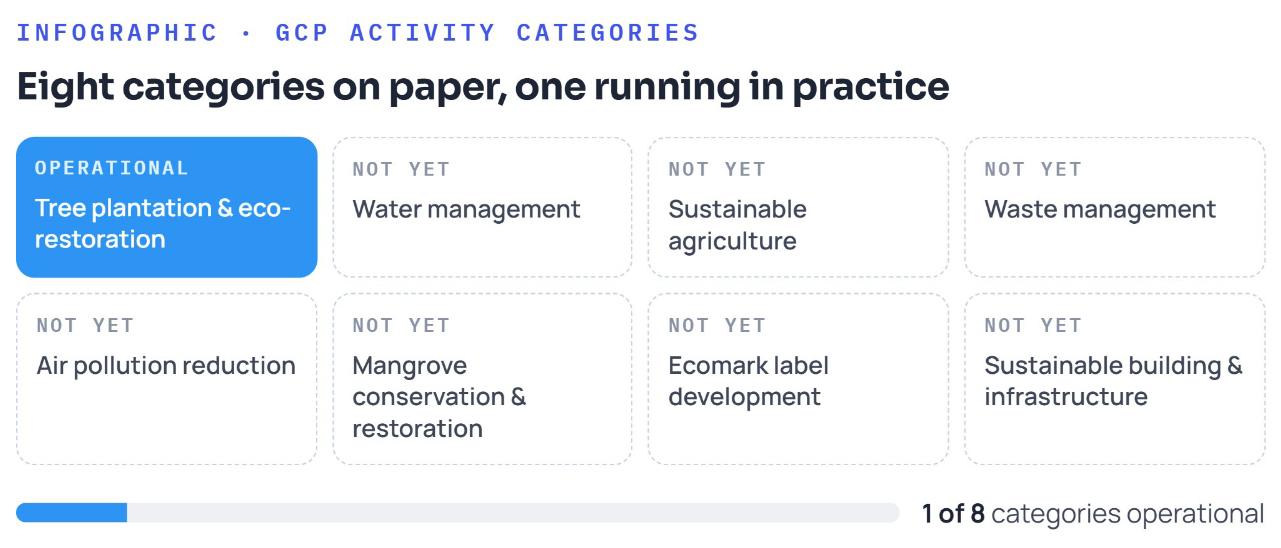
- activity categories operational: tree plantation and eco-restoration
- 1 of 8
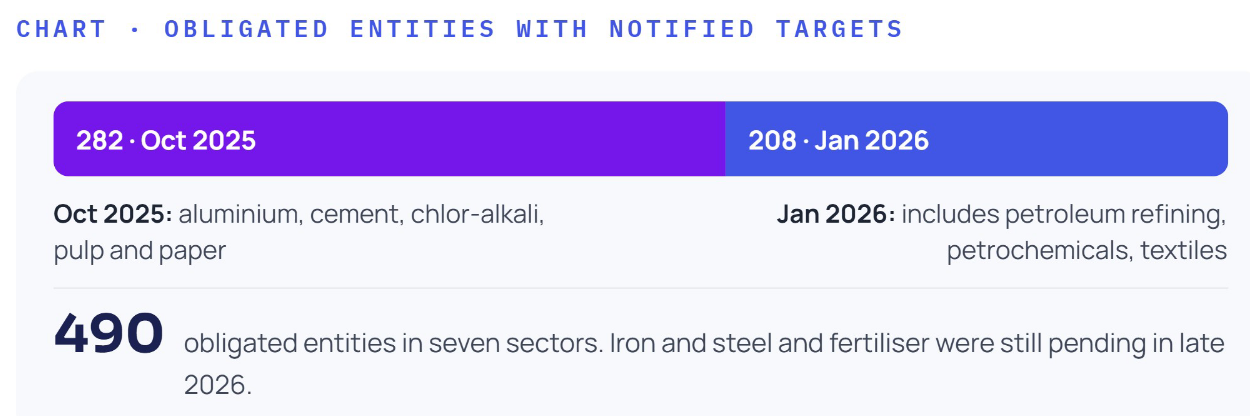
- obligated entities with notified targets in seven sectors
- 490
- trades reported by early October 2026; procedure still in draft
- 0
In this article
- Two instruments, two purposes
- Green Credits and CCCs, side by side
- How Green Credits are generated
- What a Green Credit can be used for
- How carbon credits are generated and traded
- CCC trading: a rulebook, but no trades yet
- Where the two overlap, and where they do not
- What this means for your business
- Conflating the two is not a minor terminology error
- Frequently asked questions
Two instruments, two purposes
The most important structural difference is what each instrument measures. Green Credits are activity-based: an entity earns them by completing and maintaining a qualifying environmental action. Carbon credits are emissions-based: they reflect a verified, quantified emissions outcome.
Exhibit 1
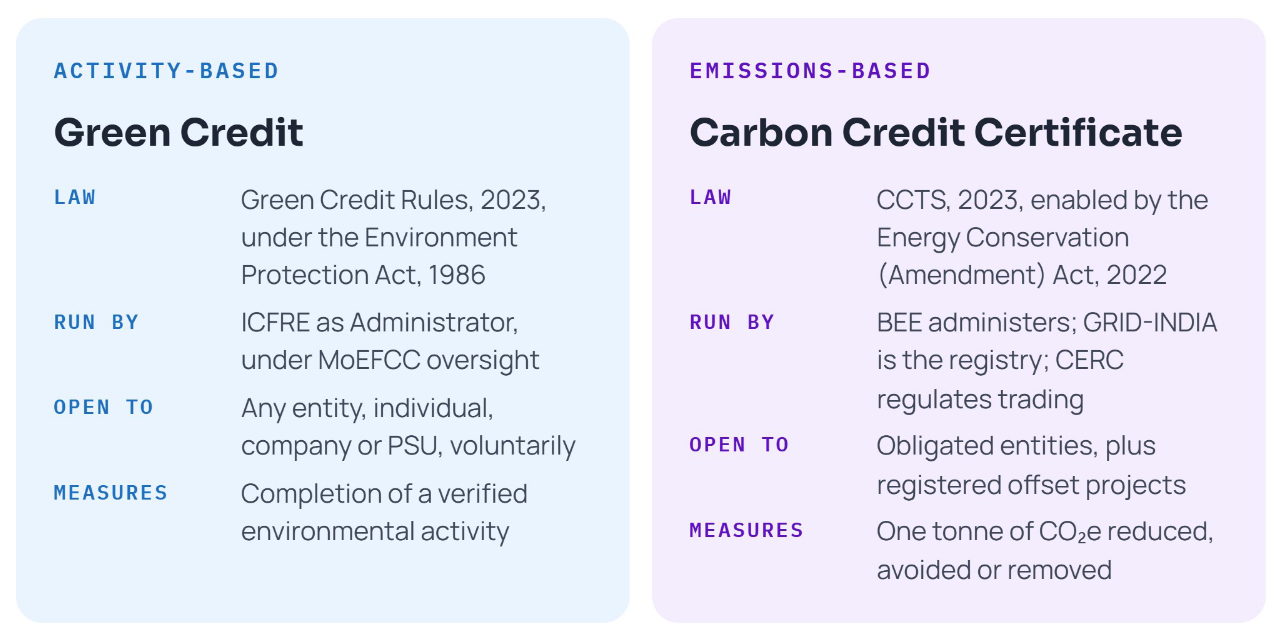
Exhibit 2
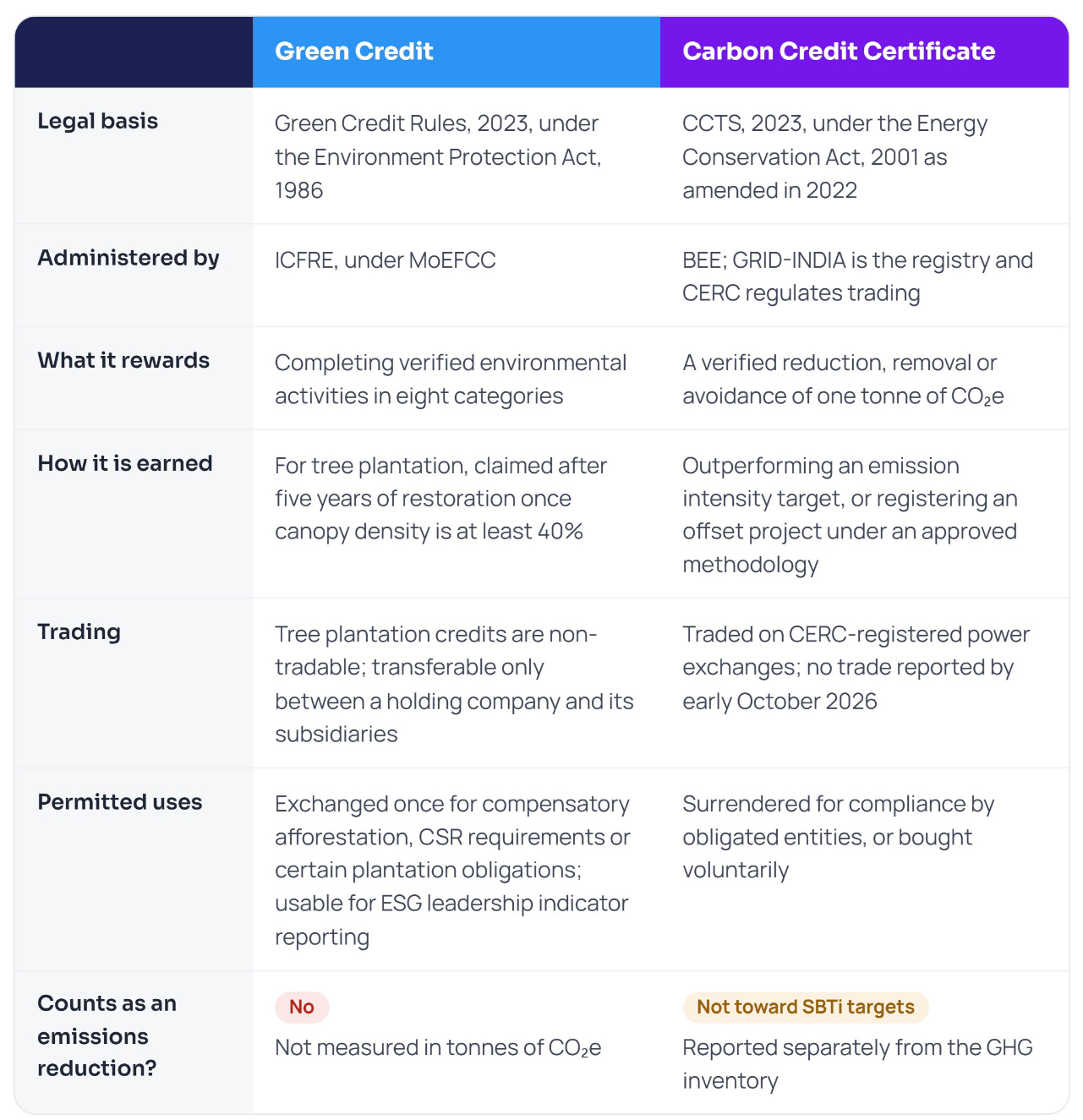
Green Credits and CCCs, side by side
Exhibit 3
View the data
| Feature | Green Credit | Carbon Credit Certificate |
|---|---|---|
| Legal basis | Green Credit Rules, 2023, under the Environment Protection Act, 1986 | CCTS, 2023, under the Energy Conservation Act, 2001 as amended in 2022 |
| Administered by | ICFRE, under MoEFCC | BEE; GRID-INDIA is the registry and CERC regulates trading |
| What it rewards | Completing verified environmental activities in eight categories | A verified reduction, removal or avoidance of one tonne of CO₂e |
| How it is earned | For tree plantation, claimed after five years of restoration once canopy density is at least 40% | Outperforming an emission intensity target, or registering an offset project under an approved methodology |
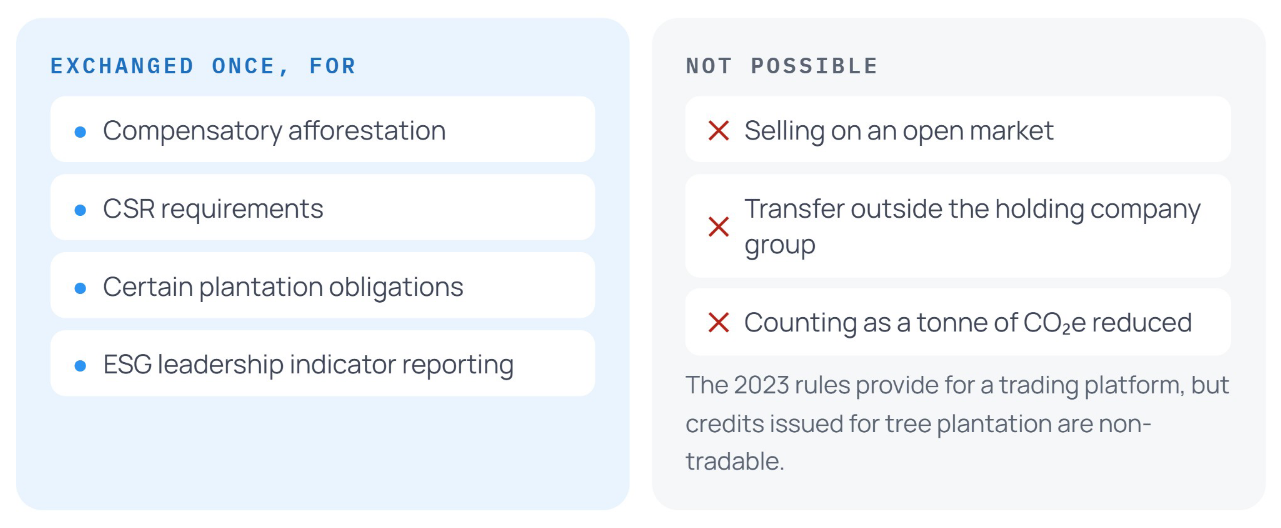
| Trading | Tree plantation credits are non-tradable; transferable only between a holding company and its subsidiaries | Traded on CERC-registered power exchanges; no trade reported by early October 2026 |
| Permitted uses | Exchanged once for compensatory afforestation, CSR requirements or certain plantation obligations; usable for ESG leadership indicator reporting | Surrendered for compliance by obligated entities, or bought voluntarily |
| Counts as an emissions reduction? | No Not measured in tonnes of CO₂e | Not toward SBTi targets Reported separately from the GHG inventory |
How Green Credits are generated
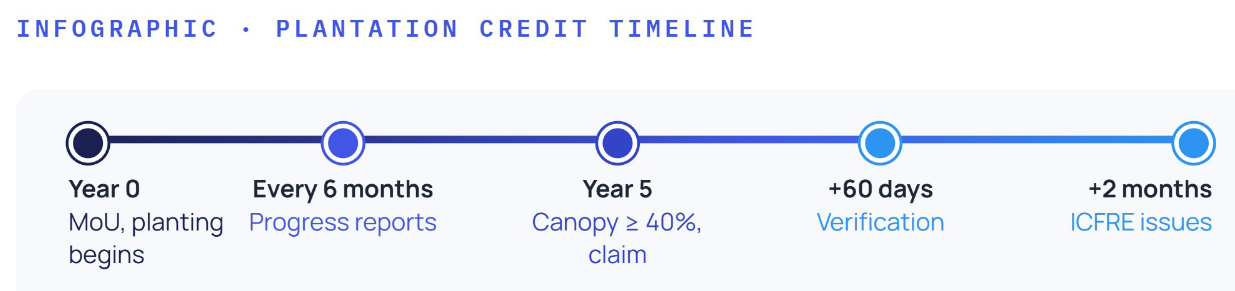
For tree plantation, the one activity now running, the process works like this.
- 1Land is identified
- 2Entity registers and signs on
- 3Restoration and reporting
- 4Verification and issuance
Exhibit 4
What a Green Credit can be used for
Exhibit 5
How carbon credits are generated and traded
Exhibit 6
View the data
| Phase | Number of Entities | Sectors Included |
|---|---|---|
| Oct 2025 | 282 | aluminium, cement, chlor-alkali, pulp and paper |
| Jan 2026 | 208 | includes petroleum refining, petrochemicals, textiles |
CCC trading: a rulebook, but no trades yet
Exhibit 7
CCC trading timeline
27 Feb 2026
CERC notifies regulations for trading CCCs on registered power exchanges.
Early Oct 2026
No CCC had traded, according to reports.
19 Oct 2026
BEE publishes a draft procedure for transactions. It is still a draft.
ESG Astraa
Where the two overlap, and where they do not
Exhibit 8
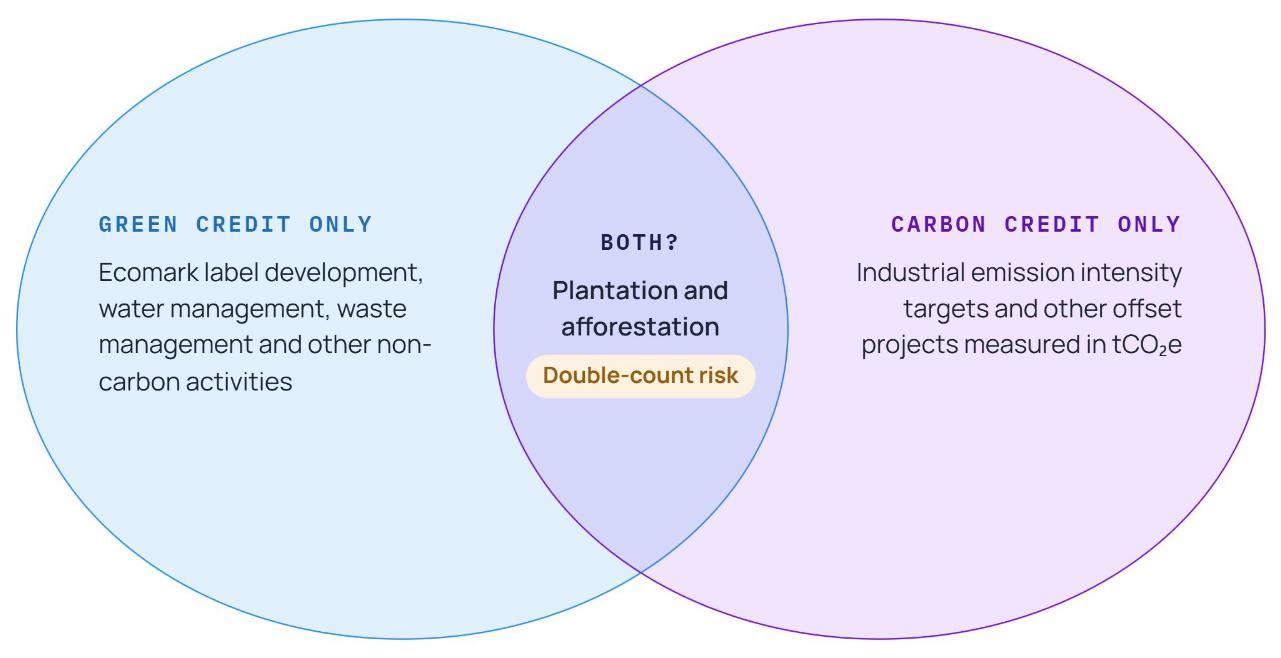
Analysts note that the CCTS offset rules exempt the Green Credit Programme from their exclusivity requirement, so the same plantation can be credited as a planted-tree unit and again for the carbon it sequesters. Even so, the two schemes keep separate registries, administrators, verification requirements and rules of use, and each credit must be claimed under its own scheme.
What this means for your business
- 1Do not count Green Credits as emissions reductions
- 2Report Green Credits for what they are
- 3Clarify your objective before choosing an instrument
- 4Track CCTS timelines if you are in a designated sector
- 5Watch for double counting
Conflating the two is not a minor terminology error
India's Green Credit Programme and the Carbon Credit Trading Scheme are both serious policy instruments, but they address different environmental problems, use different units of measurement and serve different regulatory and commercial purposes.
Frequently asked questions
- What is the key difference between India's Green Credits and carbon credits?
- Green Credits are activity-based units awarded for completing verified environmental actions (such as tree plantation), whereas carbon credits represent one verified tonne of CO₂ equivalent reduced, avoided, or removed.
- Can Green Credits be used to offset corporate greenhouse gas emissions under SBTi?
- No. Green Credits are not measured in tonnes of CO₂e and cannot be counted toward Scope 1, 2, or 3 emissions reduction targets under standards like the SBTi.
- Are tree plantation Green Credits tradable on an open market?
- No. Under the operational framework, tree plantation Green Credits are non-tradable and can only be transferred between a holding company and its subsidiaries or exchanged once for obligations like compensatory afforestation.
Where ESG Astraa can help



About the author
ESG Astraa Advisory Team. ESG Astraa helps Indian companies collect ESG data, calculate emissions and file BRSR and other disclosures, with advisors alongside the software.