Community Backlash Against Data Centres
The Social Risk Companies Overlook
Reading Time
5 min
Article Sections
6
Share Links
3
On This Page
Article Section
Introduction
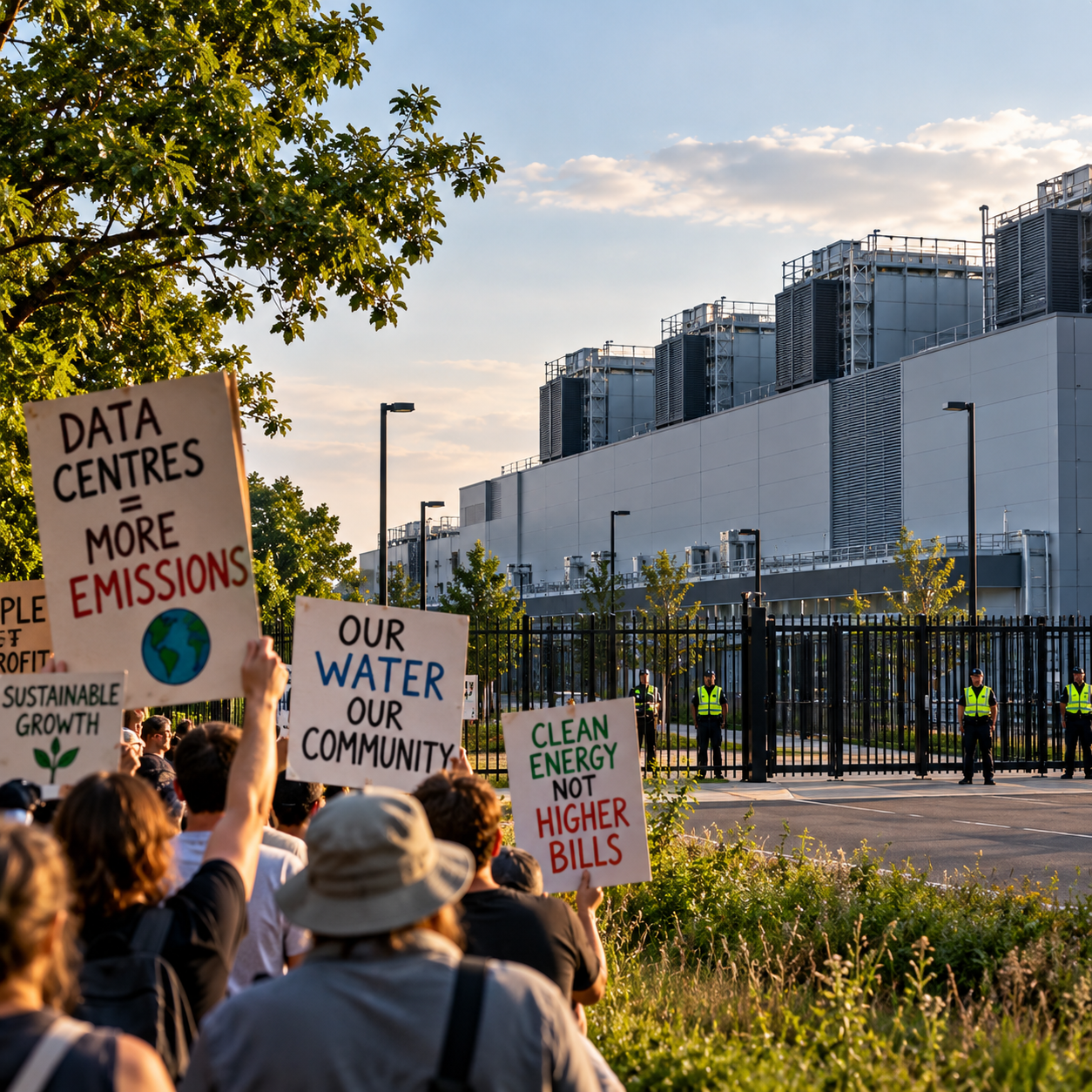
In July 2026, hundreds of residents in Thane, Maharashtra formed a human chain outside a proposed data centre, worried about how much water it would use. Press reports say the developer maintains the facility will not use water for cooling, yet the project is now under state-level review.
The pattern is not confined to India. Data Center Watch, which tracks local disputes in the United States, counts at least 120 projects worth about $198 billion blocked or delayed by local opposition in the first half of 2026. Capital is arriving faster than local acceptance.
This article argues that data centre community opposition is a siting and disclosure failure that companies can manage, not a rejection of technology, and that it belongs in the project risk register alongside permits and grid connection.
Article Section
Why Data Centres Meet Local Resistance?
A data centre concentrates several demands in one place: electricity at grid scale, land, water where cooling is water-based, round-the-clock noise from cooling and backup equipment, and construction traffic. The benefits, such as tax revenue, investment and often a limited number of permanent jobs, are spread more widely or arrive more slowly.
In India, the disputes are visible in several states. Besides Thane, press reports describe objections to a large Google project in Andhra Pradesh on environmental, energy and water grounds. An investigation cited by Rest of World found that farmers and village bodies in Telangana were kept out of land allocation for data centres. Meanwhile, governments are offering incentives, and press reports say the Union Budget 2026 extended a long tax holiday for data centre investment.
That combination matters. When public incentives are generous, residents expect transparency in return, and when land is allocated without consulting village bodies, trust is lost before construction begins.
Article Section
Data Centre Community Opposition: What Drives It?
Who carries the costs?
Local costs sit close to the site, while the benefits flow to the company, the state and digital users far away. Residents compare their own exposure to water, power and noise with a benefit they may never see. Treating that comparison as irrational misreads it.
Transparency sets the speed of opposition
One report on US projects found that those involving non-disclosure agreements, unclear ownership or undisclosed end users drew faster and sharper opposition than projects with named tenants. Secrecy signals that something is being hidden, whatever the engineering reality is.
Contested numbers fill the vacuum
In Thane, the water debate runs on a residents' estimate of 12 million litres a day against the developer's statement that no cooling water will be used. Without a published water balance, power demand and noise assessment, the largest figure in circulation becomes the working fact.
Land and process shape trust
Reports from Telangana and Andhra Pradesh suggest that opaque land acquisition and weak consultation with farmers and village bodies turn a siting decision into a fairness dispute. Once that happens, technical reassurance on water or power rarely reopens the conversation.
Engagement misses the concern
A survey reported by The Energy Mix found that only about half of data centre decision-makers hold public forums or invest in local initiatives, and fewer than a third of developers respond to water concerns. Engagement often covers topics that communities rank lower.
The investor view
For capital providers the cost of opposition is time and rework: delayed approvals, redesign after a project is public, and political scrutiny. Those costs are set at the siting stage, long before construction, which is where diligence should look.
Article Section
Strategic Implications: Managing the Social Licence
Map stakeholders before choosing a site
List residents, farmers, local authorities, utilities and nearby institutions such as schools and hospitals, and test the site with them before commitments are made.
Publish the numbers with their basis
Share expected water use and source, power demand and noise levels, together with the assumptions behind them, so residents can compare claims with evidence.
Commission an independent impact assessment
An assessment of water, power, noise, traffic and land impacts that is prepared independently and shared publicly gives disputes a common factual base.
Commit to measurable local benefits
Set specific commitments on local hiring, water, infrastructure or community support with reporting dates, so benefits can be checked, not just promised.
Set up a grievance mechanism
Provide a clear, accessible process for residents to raise complaints, with a named owner, response times and a record of outcomes.
Treat noise as a design requirement
Plan for noise from cooling and backup generators in the design, and publish monitoring results once operations begin.
Article Section
Conclusion
Community opposition to data centres is less about technology than about trust: who bears the costs, who can verify the claims and who was consulted before decisions were made.
As AI infrastructure spreads, the projects that proceed smoothly will be those that treat disclosure and local benefit as part of site selection, not as a response to protest.
Article Section
Frequently Asked Questions
Why do communities oppose data centres?
Residents raise concerns about water use, electricity supply and prices, noise, land use and a lack of transparency, often because local costs are concentrated while benefits are distant.
Do data centres strain local water and electricity supply?
They can, depending on cooling design, size and local capacity, which is why published water and power figures matter.
What social impacts should a data centre assess?
Water, power, noise, traffic, land use and livelihoods, along with how local benefits and burdens are shared.
How can data centre companies build community trust?
By consulting before site selection, publishing figures with their basis, committing to measurable local benefits and handling grievances openly.
What is a data centre grievance mechanism?
It is a formal process for residents to raise complaints and receive a response, with a named owner and set timeframes.
Keep Reading
Related Blogs

Technology
AI’s Energy Appetite
The New ESG Challenge for Tech
Read more
All Industries
Why Water Is Becoming a Board-Level ESG Priority Worldwide?
Why water risk is now a financial exposure question?
Read more
All Industries
Not Every ESG Issue Is Your Issue
A Practical Guide to Materiality Assessment
Read moreNext Step
Ready to turn ESG complexity into strategic advantage?
Talk to ESG Astraa about disclosures, climate strategy, governance controls, and execution support for your team.