How Data Centres Can Cut Water Use?
Cooling Options and Wastewater Reuse
Reading Time
4 min
Article Sections
5
Share Links
3
On This Page
Article Section
Before You Begin
Start by separating two ideas. Water withdrawal is water taken from a source, such as a utility, river or borehole. Water consumption is water that does not return to that source, for example because it evaporates. A site can cut withdrawal by switching to recycled water while consumption stays the same, so decide which one you are trying to reduce.
Have these ready: your current Water Usage Effectiveness (WUE) and the period it covers, your cooling type, your water source, local climate data, and the local rules on water sourcing and treated-water use. WUE is the litres of water used per kilowatt-hour of IT equipment energy, as defined in ISO/IEC 30134-9.
Article Section
Step-by-Step: Improving Data Centre Water Efficiency
Step 1: Measure your baseline
Meter water at the cooling plant and calculate WUE by season, not as one annual figure. Summer use can differ sharply from winter use, and an annual average hides the months that carry the most risk.
Step 2: Compare cooling options against your climate and load
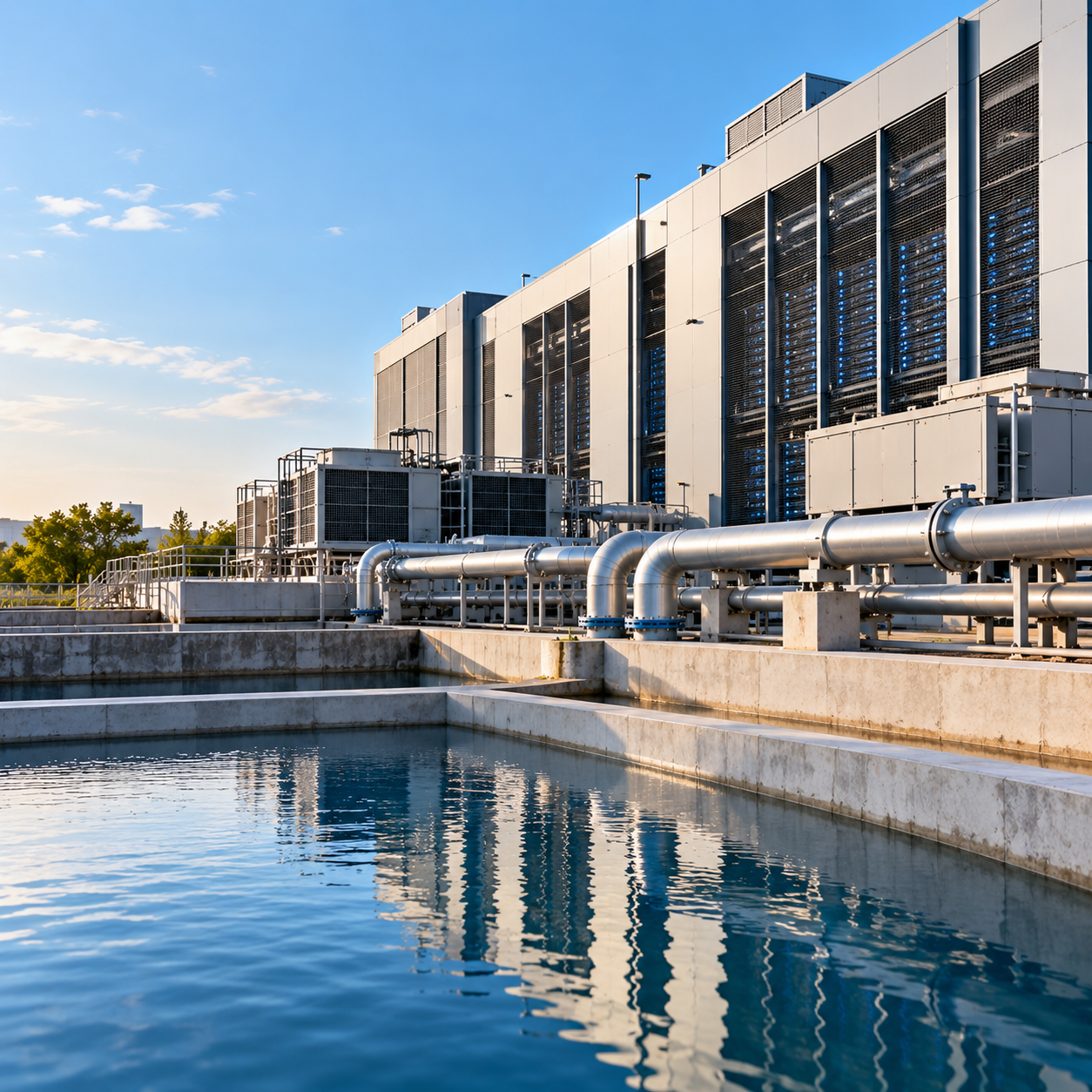
Air cooling (chillers or dry coolers) uses the least water on site but usually needs more electricity, especially in hot weather. It is mature and simple to run, suits water-stressed sites and moderate loads, and can be hard to retrofit into a water-cooled plant. Evaporative cooling (cooling towers) uses the most water on site but the least electricity. It is proven at scale and easy to add to an existing plant, but it needs careful water-quality control. It suits large loads at sites with secure water. Hybrid systems run dry most of the time and add evaporative assist when it is hot. Water use sits between the two and changes with the season. They add control complexity, are moderately hard to retrofit and suit climates with seasonal water stress. Liquid cooling (direct-to-chip or immersion) removes heat close to the chips and suits dense AI racks. Its water use depends on how the captured heat is finally rejected, which may still be through cooling towers or dry coolers. It is newer to operate and hardest to fit into existing halls, so it is most practical in new builds.
Step 3: Tune operations
Check cooling tower settings and control blowdown, which is water drained to stop minerals building up. Raise supply-air temperature within equipment limits and fix leaks. These changes usually need no new plant.
Step 4: Add reclaimed or recycled water
Treated wastewater or recycled cooling water can replace freshwater. It must be treated to the quality your cooling system needs, because minerals and organic matter cause scaling, corrosion and biofouling, which is microbial growth that blocks pipes and heat exchangers. Add continuous water-quality monitoring and confirm local approvals for sourcing and using treated water.
Step 5: Redesign where retrofit allows
For new halls or expansions, choose the heat-rejection method against local water stress, not only efficiency. Hybrid or liquid cooling with dry heat rejection can lower on-site water use.
Step 6: Monitor, report and review
Track WUE by season and the share of water from recycled or reclaimed sources. Review before each pre-monsoon summer so cooling choices and water contracts are ready for the tightest months.
Article Section
Tips, Mistakes and Troubleshooting
Mistake: treating recycled water as zero water use
Recycled water used in cooling towers still evaporates. Report withdrawal and consumption separately.
Mistake: choosing waterless cooling without checking grid water
Higher electricity demand can move water use to power plants. Compare on-site and indirect water together.
Tip: plan for the driest months
Size water storage, backup sources and cooling mode switching for peak summer, not the annual average.
Troubleshooting: scaling, corrosion or biofouling with reclaimed water
These usually point to treatment or monitoring gaps. Review treatment steps and sampling frequency before blaming the cooling equipment.
After implementation: publish your results
Report WUE with its measurement period, cooling type and water source so readers can compare like with like.
Article Section
Conclusion
Reducing data centre water use follows a clear order: measure by season, tune operations, source water smarter, then redesign cooling where new capacity allows. Each step protects reliability while easing pressure on local water.
Start with a seasonal baseline, because every cooling and water-sourcing decision depends on it.
Article Section
Frequently Asked Questions
How can data centres reduce water use?
Measure WUE by season, tune cooling operations, use reclaimed water where approved and match the cooling design to local climate and water stress.
Which data centre cooling system uses the least water, and does waterless cooling increase energy use?
Air cooling uses the least on-site water, but it usually needs more electricity, especially in hot weather.
Can wastewater be reused for data centre cooling?
Yes, if it is treated to the quality the cooling system needs, monitored continuously and approved under local rules.
Is liquid cooling more water-efficient?
It depends on how the captured heat is rejected, because that stage may still use water.
What is a good WUE for a data centre?
No single benchmark fits every site, so compare against similar climates and always report the measurement period.
Keep Reading
Related Blogs
Next Step
Ready to turn ESG complexity into strategic advantage?
Talk to ESG Astraa about disclosures, climate strategy, governance controls, and execution support for your team.