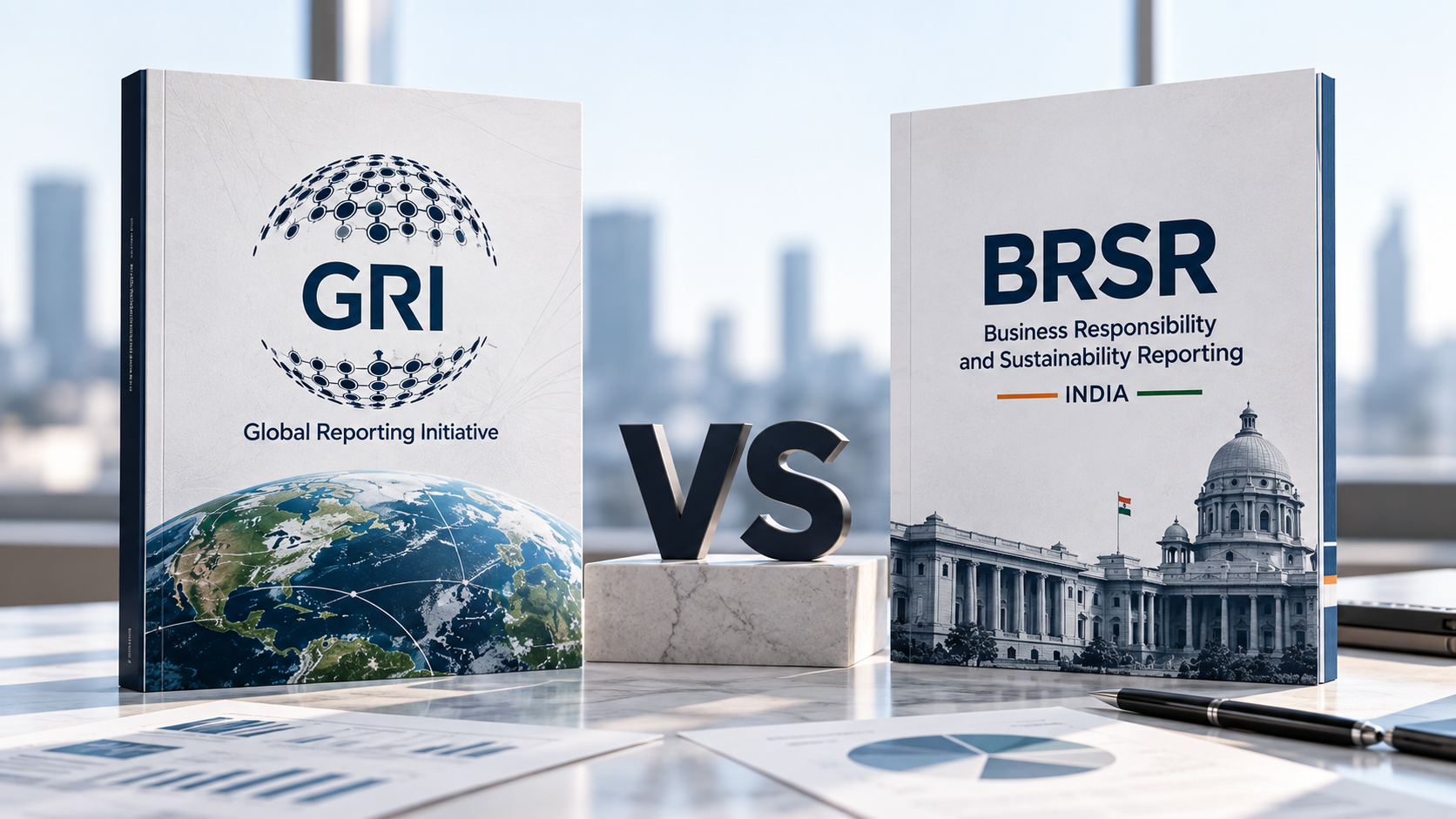
GRI vs BRSR in India
What Overlaps and What Is Different?
Reading Time
5 min
Article Sections
6
Share Links
3
On This Page
Article Section
Introduction
A finance team, a sustainability team and a supplier questionnaire all ask for similar data in three different formats. Nobody is sure which answers can be reused, and the same question returns every reporting cycle.
The question is live for Indian companies because SEBI keeps refining BRSR Core, assessment or assurance and value-chain disclosures, while many companies also report to global audiences. Suppliers to listed companies may also be asked for the data behind value-chain disclosures.
This guide to GRI vs BRSR India shows what overlaps, what stays framework-specific and how to plan one data system for both.
Article Section
What BRSR and GRI Are?
BRSR is the Business Responsibility and Sustainability Report. SEBI introduced it in May 2021, and it requires the top 1,000 listed companies by market capitalisation to report on environmental, social and governance matters as part of their annual report, from FY 2022-23. It uses essential indicators, which are mandatory, and leadership indicators, which are voluntary.
GRI, the Global Reporting Initiative, publishes a modular set of Universal, Sector and Topic Standards. They help an organisation report its impacts on the economy, environment and people, and any organisation can use them, whatever its size, type or location.
The core contrast is simple. BRSR is a regulatory format for India. GRI is a global Standards system that companies choose to use.
GRI and the Bombay Stock Exchange have also published a document that links the GRI Standards to the BRSR framework. GRI says most BRSR indicators are covered by the GRI Standards, which explains why the two overlap.
Article Section
GRI vs BRSR India: Overlaps and Differences
Where they overlap?
GRI says most BRSR indicators are reflected in the GRI Standards, so a company that produces a GRI report can use much of the same data for its BRSR. The linkage document cross-references BRSR requirements to GRI disclosures.
Legal status and coverage
BRSR is required from the top 1,000 listed companies under SEBI's listing rules. GRI is voluntary, and any organisation can use it. A GRI claim, in accordance with or with reference to the Standards, describes how far the Standards were applied.
How content is chosen?
Under GRI 3, each organisation determines its material topics from its most significant impacts. BRSR asks for a prescribed set of indicators in a fixed format, so companies in scope answer the same core set of questions.
Assurance
BRSR Core is a focused subset of BRSR indicators. It needs assessment or assurance, phased in by market capitalisation from the top 150 companies in FY 2023-24 to the top 1,000 in FY 2026-27. GRI recommends external assurance but does not require it.
Value-chain disclosures
SEBI's value-chain disclosures apply to the top 250 companies on a voluntary basis from FY 2025-26. The value chain covers partners that individually account for 2% or more of purchases or sales, and a company may limit coverage to 75%. Assessment or assurance of these disclosures is also voluntary, from FY 2026-27. GRI handles value chain differently, through business relationships when impacts are identified.
Can GRI replace BRSR?
No. SEBI requires BRSR from companies in scope, and a GRI report does not by itself meet that requirement. GRI data can support the BRSR, and GRI 1 also lets a company use selected GRI Standards for a specific purpose under a with reference claim.
Article Section
Building One Data System for Both
Map first
Start with the GRI and BSE linkage document to see which BRSR indicators have a GRI counterpart.
Mark framework-specific items
Keep a list of indicators that exist in only one framework, so they are not lost when data is reused.
Check definitions and boundaries
Scope, units and calculation rules can differ, so confirm them before sharing a figure across reports.
Keep assurance evidence together
BRSR Core needs source records and calculation trails, so store them where the assessment or assurance provider can reach them.
Watch SEBI updates
SEBI has changed BRSR Core and value-chain rules more than once, so confirm the current position in the latest circular before each reporting cycle.
Match the GRI claim to what is met
Use in accordance only if all nine requirements are met, and with reference otherwise.
Article Section
Conclusion
BRSR is the regulatory format for India, and GRI is a global system for reporting impacts. The overlap is real, but it is not complete, and the gaps are where the extra work sits. Plan the two together instead of building two separate data sets.
List every BRSR indicator, mark the GRI disclosure that covers it, and treat the unmatched items as framework-specific work.
Article Section
Frequently Asked Questions
What is the difference between GRI and BRSR?
BRSR is SEBI's mandatory disclosure format for India's top 1,000 listed companies, while GRI is a voluntary global set of Standards for reporting impacts.
Is GRI mandatory in India?
No, SEBI requires BRSR, and GRI is a voluntary framework that companies can choose to use.
Can GRI replace BRSR?
No, listed companies in scope must still file BRSR, although GRI says a company producing a GRI report can use much of the same data for it.
What is BRSR Core?
BRSR Core is a focused subset of BRSR indicators that needs assessment or assurance, phased in by market capitalisation up to the top 1,000 companies in FY 2026-27.
Who must report under BRSR?
The top 1,000 listed companies by market capitalisation must file BRSR as part of their annual report.
Keep Reading
Related Blogs

Next Step
Ready to turn ESG complexity into strategic advantage?
Talk to ESG Astraa about disclosures, climate strategy, governance controls, and execution support for your team.