What Is a "Just Transition" ?
Why Is It Reshaping Global Energy Policy?
Reading Time
5 min
Article Sections
6
Share Links
3
On This Page
Article Section
Introduction
In coal towns across South Africa, Indonesia, and parts of eastern Europe, the same question keeps surfacing at public hearings: what happens to the workers and the local economy once the power plant closes. Energy policy that answers only the emissions question and ignores that one tends to stall, and increasingly, so does the capital behind it.
That gap is why just transition has moved from a phrase used in labor and civil society circles into a standard clause in national energy strategies, multilateral funding agreements, and corporate transition plans. Investors assessing transition risk now ask not just how fast a company or country plans to decarbonize, but who bears the cost of that speed.
This article explains what a just transition actually means, where the concept comes from, and what it now requires of companies and policymakers managing an energy shift.
Article Section
What a Just Transition Actually Means?
The term just transition originates in the labor movement, where it described support for workers displaced by environmental regulation, long before climate policy adopted it. The International Labour Organization formalized this thinking in its 2015 Guidelines for a Just Transition, which frame the shift to environmentally sustainable economies as one that must also advance decent work, social inclusion, and poverty eradication. The concept entered international climate diplomacy directly: the preamble to the Paris Agreement references the imperatives of a just transition of the workforce.
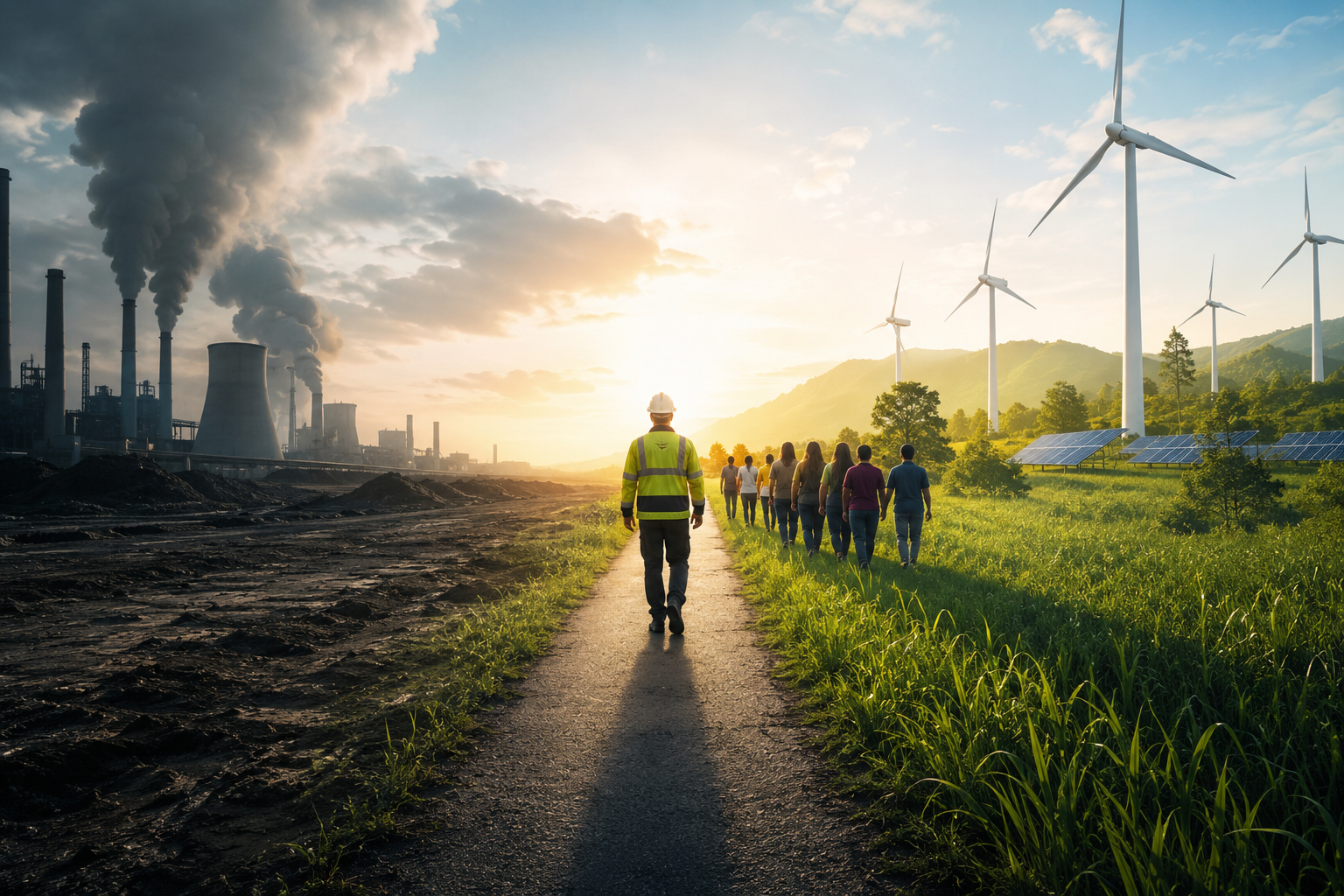
At its core, a just transition rests on a simple premise: decarbonization is not automatically fair. Closing a coal plant reduces emissions immediately, but if the workers who ran it, the suppliers who served it, and the town that depended on its tax revenue have no alternative, the transition creates new social and economic damage even as it fixes an environmental one. A just transition asks planners to solve for both outcomes at once, not sequence one after the other.
Article Section
How Just Transition Works in Practice?
How Just Transition Principles Shape Policy Design?
National energy transition plans increasingly build in phased timelines, worker retraining programs, and regional economic diversification funds alongside emissions targets. Just Energy Transition Partnerships, agreed between developed economies and countries such as South Africa, Indonesia, and Vietnam, structure international climate finance explicitly around this pairing: funding is tied to both a coal phase-down schedule and a parallel plan for affected workers and communities.
The Two Dimensions Combined
A just transition operates on two linked tracks. The first is the pace and sequencing of decarbonization itself: how quickly a coal fleet retires, how fast fossil fuel subsidies phase out. The second is the social and economic architecture built around that pace: reskilling programs, pension protections, local infrastructure investment, and consultation with affected communities before decisions are finalized, not after.
Where It Surfaces in Investor and Regulatory Expectations?
Frameworks such as the Task Force on Climate-related Financial Disclosures ask companies to describe their transition plans, and workforce and community impact is increasingly part of that narrative. Lenders and development finance institutions financing coal retirement now commonly request a just transition component alongside the technical closure plan.
Article Section
What This Means for Companies in Transition-Exposed Sectors?
What to Track If You Operate in a Transition-Exposed Region?
Companies with assets in coal-linked or fossil-fuel-dependent regions should map workforce and supplier exposure to any planned asset retirement, not just the emissions timeline.
A Common Mistake
Treating just transition as a communications exercise, announced once an asset closure is already decided, rather than a planning input considered from the start, is the most common failure. It typically shows up later as delayed permits, community opposition, or renegotiated financing terms.
An Actionable Step for ESG and Sustainability Teams
Build workforce and community impact into transition planning documents early and reference it explicitly in TCFD-aligned or equivalent disclosure, rather than treating it as a separate corporate social responsibility line item.
Article Section
Conclusion
A just transition is not an add-on to climate policy. It is increasingly treated as a precondition for a transition plan to be considered credible by investors, regulators, and the communities it affects.
As more countries structure coal phase-down and energy transition finance around this principle, companies operating in transition-exposed sectors and regions should expect workforce and community impact to be a standard, not optional, part of how their transition plans are assessed.
Article Section
Frequently Asked Questions
What does "just transition" mean?
It means shifting to a low-carbon economy in a way that protects workers and communities from being left behind, not only reducing emissions.
Where does the term come from?
It originated in the labor movement and was formalized in the International Labour Organization's 2015 Guidelines for a Just Transition, before entering the Paris Agreement's preamble.
How is a just transition different from an energy transition?
An energy transition refers to the shift itself, such as retiring coal plants, while a just transition specifically addresses the social and economic support built around that shift.
Who is responsible for delivering a just transition?
Responsibility is shared among governments setting policy, companies managing asset retirement and workforce planning, and financiers structuring transition-linked funding.
What should a company do to build just transition into its planning?
Map workforce and community exposure to any planned asset retirement early, and reflect that planning in transition-related disclosure rather than treating it as a separate initiative.
Keep Reading
Related Blogs

All Industries
The Business Case for ESG in India Is No Longer About Ethics, It's About Market Access
Why capital cost, contract eligibility, and index access now drive ESG urgency more than ethics does.
Read more
ESG Reporting
GRI vs BRSR
Reconciling Two Reporting Standards Without Duplicating Work
Read more
Corporate Finance
From Compliance to Capital
Why ESG Is Now a CFO Conversation, Not Just a Sustainability One
Read moreNext Step
Ready to turn ESG complexity into strategic advantage?
Talk to ESG Astraa about disclosures, climate strategy, governance controls, and execution support for your team.