Beyond Scope 1, 2, and 3
What Avoided Emissions (Scope 4) Actually Measure

Reading Time
5 min
Article Sections
5
Share Links
3
On This Page
Article Section
What Scope 1, 2, and 3 Measure, and Where Avoided Emissions Fit?
Scope 1 covers a company's direct emissions, from its own facilities and vehicles. Scope 2 covers emissions from purchased electricity, steam, heat, or cooling. Scope 3, first published as a standard in 2011, covers emissions across 15 categories of a company's value chain, from purchased goods and services through to the use of sold products, sitting outside the company's direct control.
Avoided emissions, sometimes informally called Scope 4, is not an official GHG Protocol scope category at all. It refers to emissions reductions that occur outside a company's value chain because someone else used its product or service, compared to what would have happened under a counterfactual baseline scenario without that product or service.
The distinction matters because Scope 1, 2, and 3 use attributional accounting, measuring emissions that actually occurred and can be traced to a company's operations. Avoided emissions use consequential accounting, modeling a hypothetical difference against a scenario that never happened. These are fundamentally different kinds of numbers.
Article Section
How Avoided Emissions Are Actually Calculated?
The calculation rests on a counterfactual comparison
An avoided emissions claim compares emissions in a scenario where a product or service is used against emissions in a baseline scenario where it is not. The GHG Protocol's own examples include a cold-water detergent avoiding the emissions of heating water, fuel-saving tires avoiding the emissions of extra fuel burned, and energy-efficient ball bearings or lower-carbon data centres avoiding the emissions of a less efficient alternative.
It is a comparative number, not an absolute one
Unlike Scope 1, 2, and 3, which report emissions a company actually caused, an avoided emissions figure reports a modeled gap between two scenarios. That means the result depends heavily on which baseline is chosen. Change the baseline assumption, and the reported avoided emissions figure changes with it, even if nothing about the product itself has changed.
There is still no official GHG Protocol standard for it
As of 2026, avoided emissions accounting is still being developed by the GHG Protocol's Actions and Market Instruments workstream, which is working toward sector-agnostic requirements and guidance. Its March 2026 Phase 1 Progress Update white paper explicitly states that its content is draft and subject to change, following a public consultation that closed in January 2026. Separately, ISO's 14064-1 standard is also working on its own draft definition of avoided emissions.
Misuse tends to happen when avoided emissions get mixed into a company's own footprint
Because avoided emissions and Scope 1, 2, and 3 emissions are measuring fundamentally different things, one a modeled external difference and the other a company's actual emissions, combining them into a single inventory number misrepresents both. The more common, and more defensible, practice is to report avoided emissions separately, with the underlying assumptions disclosed alongside the figure.
Article Section
How to Read or Make an Avoided Emissions Claim Responsibly?
Ask what baseline was used before accepting the number
Since the entire figure depends on the counterfactual scenario chosen, request the specific assumptions behind the comparison before treating an avoided emissions claim as reliable.
Never net avoided emissions against Scope 1, 2, or 3 totals
Keep the two categories reported separately. One measures a company's actual emissions; the other measures a modeled difference against a scenario that did not happen, and combining them overstates progress on either front.
Expect the methodology to keep changing over the next year or two
The GHG Protocol's Actions and Market Instruments guidance is still in Phase 1, with feedback from the October 2025 to January 2026 consultation still being incorporated. Any avoided emissions methodology adopted today may need revision once final guidance is published.
Apply extra scrutiny to marketing claims specifically
Given the GHG Protocol's own acknowledgment that these claims are often unverifiable or inaccurate, disclosure and communications teams should request the underlying data before repeating a product-level avoided emissions claim externally.
Article Section
Conclusion
Avoided emissions measure something genuinely different from Scope 1, 2, and 3: a modeled comparison against a scenario that never occurred, rather than emissions a company actually caused. That difference is exactly why the number needs its own disclosure treatment, not a place inside the standard inventory.
Until the GHG Protocol's Actions and Market Instruments guidance moves from draft to finalised standard, boards asking about Scope 4 should treat every avoided emissions figure they see as a claim to be checked, not a number to be taken at face value.
Article Section
Frequently Asked Questions
What are avoided emissions, or Scope 4?
Emissions reductions that occur outside a company's value chain because a product or service was used, measured against a counterfactual baseline scenario in which it was not.
Is Scope 4 an official GHG Protocol category?
No; the GHG Protocol has not finalised a standard for avoided emissions, though its Actions and Market Instruments workstream is developing sector-agnostic guidance for it.
Why does the GHG Protocol say avoided emissions claims are often unreliable?
Because the calculation depends entirely on the counterfactual baseline chosen, and without a finalised standard, companies can select assumptions inconsistently.
Can avoided emissions be subtracted from a company's Scope 1, 2, and 3 total?
No; avoided emissions measure a modeled external difference, not the company's own actual emissions, so the two figures should be reported separately.
When will an official avoided emissions standard be available?
As of 2026, the GHG Protocol's guidance remains in draft form following a public consultation that closed in January 2026, with no finalised standard yet published.
Keep Reading
Related Blogs
All Industries
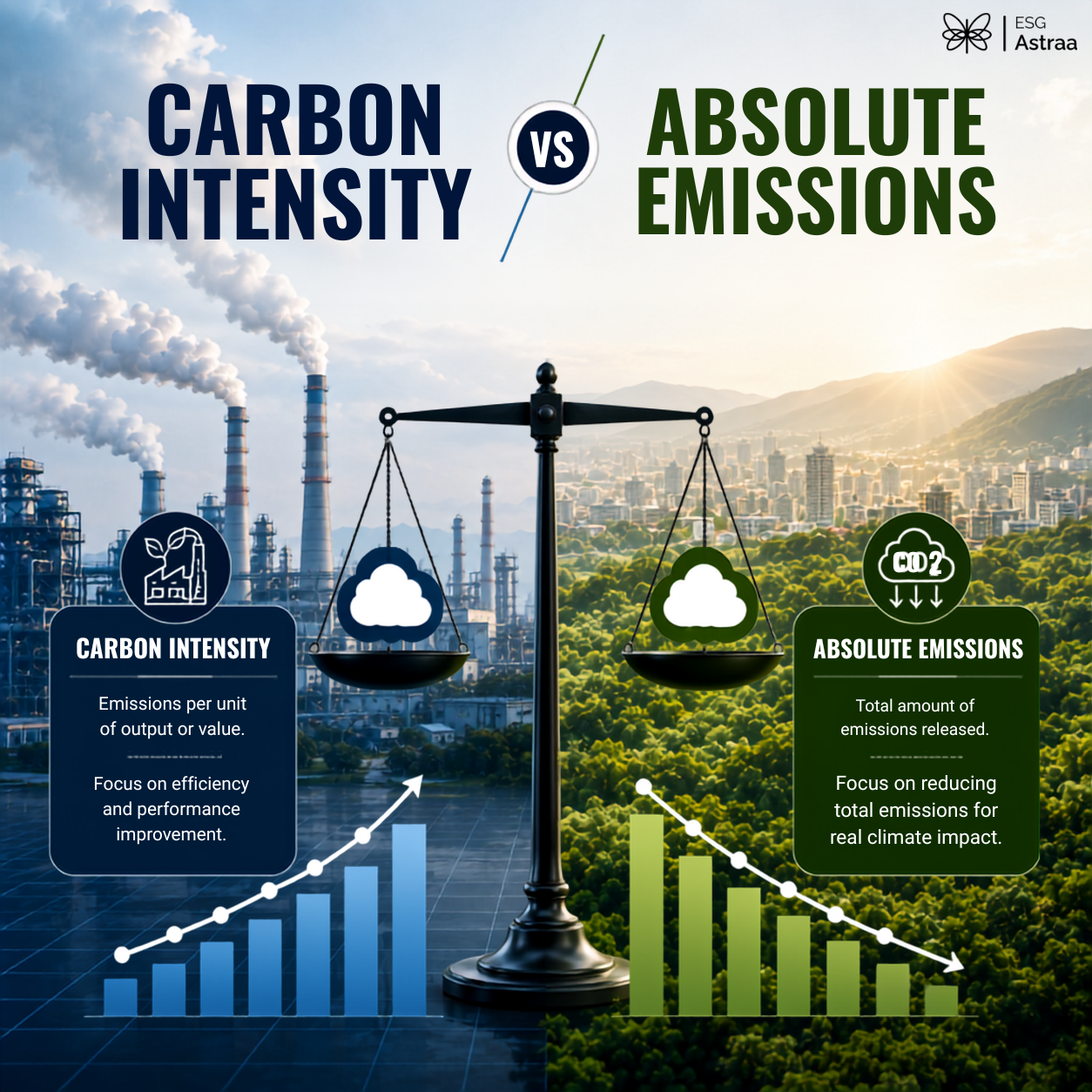
Carbon Intensity vs Absolute Emissions
Why the Metric You Choose Changes Your ESG Story Completely?
Read more
All Industries
What Happens When ESG Disclosure and Business Reality Don't Match
The Greenwashing Risk Explainer
Read more
All Industries
Scope 3 Is No Longer Optional
Here Is Exactly Where Indian Companies Are Getting Stuck
Read moreNext Step
Ready to turn ESG complexity into strategic advantage?
Talk to ESG Astraa about disclosures, climate strategy, governance controls, and execution support for your team.