ESG in the Global Healthcare Sector
What's Driving the New Scrutiny?

Reading Time
5 min
Article Sections
5
Share Links
3
On This Page
Article Section
Why Healthcare Draws an Outsized Share of ESG Attention?
Healthcare's economic footprint alone explains part of the scrutiny. The sector's $10.6 trillion in 2025 expenditure is led by the United States at $3.3 trillion, followed by China, Germany, Japan, and the UK, and its 65 million direct jobs plus 250 million supply chain workers give it a scale that regulators and investors cannot treat as a niche category.
Its environmental footprint is proportionate to that scale. The sector's 4.6% share of global greenhouse gas emissions sits alongside a pharmaceutical pollution problem that is specific to healthcare: single-use plastics and pharmaceutical pollution contaminate water systems annually, and over 631 active pharmaceutical ingredients have already been detected in global freshwater.
On the regulatory side, healthcare organisations now sit inside multiple overlapping disclosure regimes at once. The EU's CSRD requires Scope 1 to 3 emissions reporting and third-party audits from more than 50,000 companies, with non-compliance risking multi-million euro penalties. India's BRSR is mandatory for the country's top 1,000 listed companies, and healthcare companies specifically must align with BRSR Core, which covers product lifecycle and supply chain KPIs. Meanwhile, HIPAA and GDPR impose strict patient data governance requirements, with breaches capable of costing $10 million to $50 million or more in settlements, and penalties reaching up to $1.9 million per violation category per year for healthcare organisations.
Article Section
What Is Actually Driving the Scrutiny?
Pharmaceutical pollution creates a risk category most sectors simply don't have
The presence of over 631 active pharmaceutical ingredients in global freshwater is not a generic pollution story. These compounds accumulate in aquatic food chains, causing endocrine disruption, and pharmaceutical pollution is directly linked to amplifying antimicrobial resistance, a global health security concern that has no equivalent in most other industries' environmental footprints.
Disclosure regimes now apply directly and specifically to healthcare
This is not generic ESG reporting pressure. CSRD's Scope 1 to 3 requirements and third-party audit mandate apply to more than 50,000 companies, and India's BRSR Core framework specifically requires healthcare companies to report on product lifecycle and supply chain KPIs, meaning the disclosure obligations are built around the sector's actual operations, not adapted from a generic template.
Data governance carries the sector's highest financial exposure
Healthcare data breaches have increased by 93% since 2018, with the average cost rising to $10.9 million in 2024, more than double the cross-sector average. Combined with HIPAA and GDPR penalties reaching up to $1.9 million per violation category per year, data governance is arguably the single highest financial risk line inside a healthcare organisation's ESG exposure, not a secondary compliance item.
Most of the sector is still unprepared for this level of scrutiny
The majority of healthcare organisations still operate at Ad Hoc or Emerging ESG maturity levels, lacking formal programmes and structured policies, and only 14% have reached Integrated or Leading maturity, where ESG is embedded in decision-making and patient outcomes. That gap between what regulation now requires and what most organisations actually have in place is itself a large part of why scrutiny is intensifying.
Article Section
Where Healthcare Organisations Should Focus First?
Treat pharmaceutical and API risk as its own category, not folded into general emissions reporting
Because active pharmaceutical ingredients behave differently in the environment than routine emissions, bioaccumulating and driving antimicrobial resistance, this risk needs its own assessment and disclosure line rather than being absorbed into a broader environmental metric.
Map disclosure obligations market by market rather than assuming one approach covers all
CSRD and BRSR have different scope thresholds, reporting requirements, and KPI expectations. A healthcare organisation operating across the EU and India needs to treat these as two distinct compliance exercises, not one global template.
Treat data governance as core ESG risk, not a separate IT function
Given breach costs averaging $10.9 million and penalties reaching $1.9 million per violation category per year, patient data governance belongs in the same risk register as environmental and supply chain exposure, reviewed at the same governance level.
Close the ESG maturity gap deliberately, starting with formal governance structures
With only 14% of organisations at Integrated or Leading maturity, closing this gap is itself the largest available opportunity. Organisations that reach higher maturity levels capture 2.8 times the financial benefit of those still at emerging stages, which makes formal ESG governance a financial decision as much as a compliance one.
Article Section
Conclusion
Healthcare's ESG scrutiny is not arriving from a single direction. It is the combined result of a sector-specific pollution problem, disclosure regimes built around the industry's actual operations, and data governance stakes higher than almost any other sector faces.
With most organisations still operating well below the ESG maturity level this scrutiny now demands, the gap between where the sector stands and where regulation and financial incentive are both pushing it is the story to watch over the next few years.
Article Section
Frequently Asked Questions
How large is the global healthcare sector's economic footprint?
The sector accounted for $10.6 trillion in global expenditure in 2025, representing 10.3% of world GDP, and employs 65 million people directly with 250 million more across its supply chains.
Why does pharmaceutical pollution matter for healthcare ESG specifically?
Over 631 active pharmaceutical ingredients have been detected in global freshwater, and this pollution is linked to bioaccumulation, endocrine disruption, and antimicrobial resistance, risks unique to the sector.
Which disclosure regimes apply to healthcare organisations?
The EU's CSRD requires Scope 1-3 emissions reporting from over 50,000 companies, and India's BRSR is mandatory for the top 1,000 listed companies, with healthcare firms required to align with BRSR Core.
How costly are healthcare data breaches compared to other sectors?
Healthcare data breaches averaged $10.9 million in 2024, an increase of 93% since 2018, and more than double the cross-sector average breach cost.
How ESG-mature is the healthcare sector currently?
Most healthcare organisations operate at Ad Hoc or Emerging ESG maturity levels, and only 14% have reached Integrated or Leading maturity.
Keep Reading
Related Blogs
All Industries
Scope 3 Is No Longer Optional
Here Is Exactly Where Indian Companies Are Getting Stuck
Read more
All Industries
What Happens When ESG Disclosure and Business Reality Don't Match
The Greenwashing Risk Explainer
Read more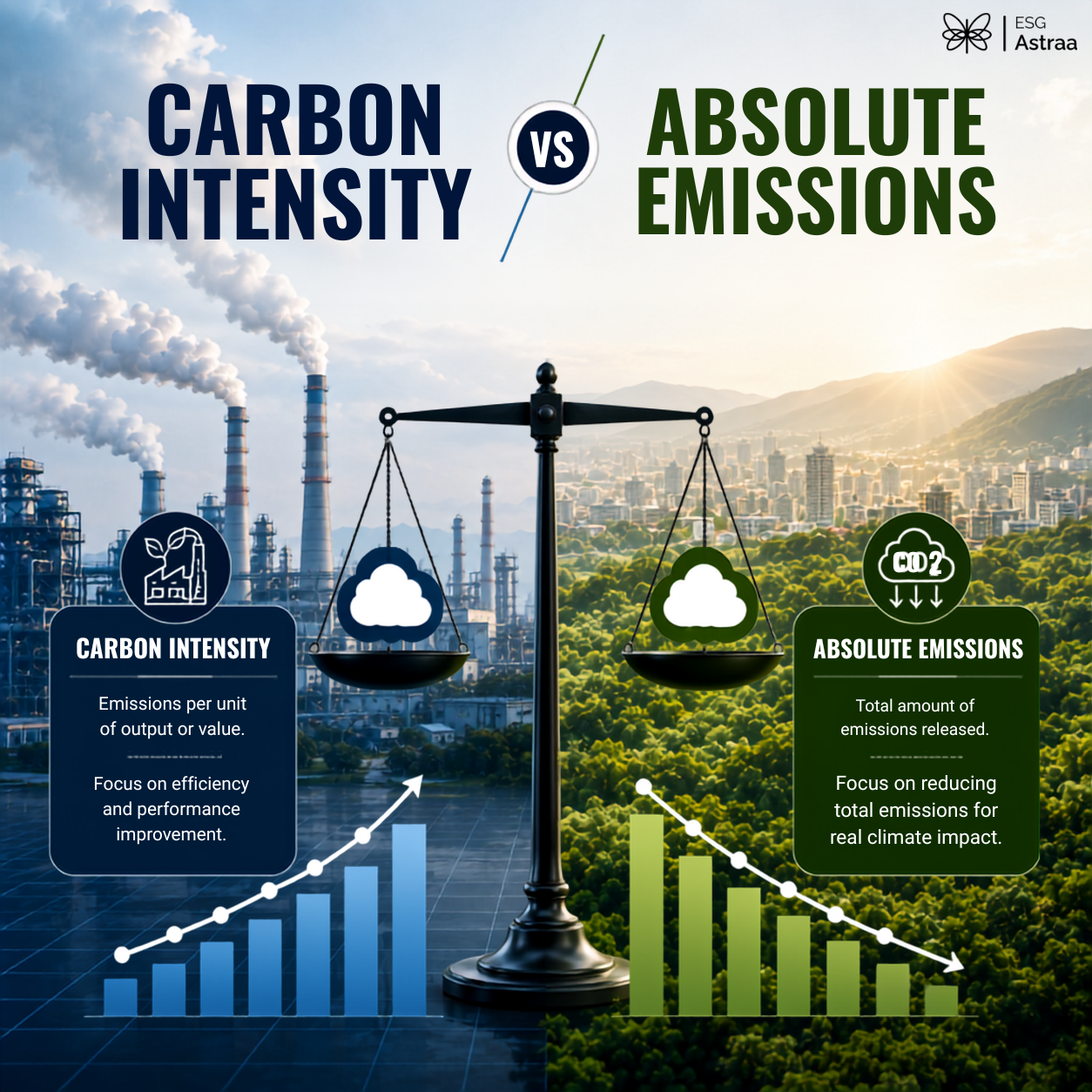
All Industries
Carbon Intensity vs Absolute Emissions
Why the Metric You Choose Changes Your ESG Story Completely?
Read moreNext Step
Ready to turn ESG complexity into strategic advantage?
Talk to ESG Astraa about disclosures, climate strategy, governance controls, and execution support for your team.